Posts

Showing posts with the label History

International Currency #1: How the Dollar Took Over

How does an international currency get displaced? Does the contender need to do pre-work to take over when the transition point arrives? Way Yuhl looks at how the US dollar took over from the British pound as the international currency. As the colonial superpower, Britain ruled. The pound was the international reserve currency, and British banks handled most global commerce. “Deals that had nothing to do with Britain ran through British institutions.”   The popular belief is that the US dollar replaced the pound due to the second World War, the complete destruction of Europe and Britain, and the beginning of the end of the British empire. True, but that was just the tipping point. In the decades leading to that point, America had been preparing…   From the early 1900’s onwards, America progressively overtook Britain as the world’s largest industrial economy. It produced more steel than Britain and Germany combined. But that alone was never going to be enough to beco...

Dubai #1: Ignored

Image
Dubai. The UAE. The posterchild of how a country can continue to be rich, even when the oil runs out. The story behind that is interesting, as I learnt as I read this (brief) history of Dubai by Tomas Pueyo. ( Note : Through this blog, Dubai means the entire emirate by the same name, not just the one city named Dubai).   The founder of Dubai, Sheikh Rashid bin Saeed Al Maktoum, feared this: “ My grandfather rode a camel; my father rode a camel. I ride a Mercedes. My son rides a Land Rover, and my grandson will ride a Land Rover. But his son will ride a camel.” Al Maktoum wanted to avoid that last line. And boy, has he succeeded: “Today, Dubai is not only a bustling city. It’s one of the most dynamic city-states on Earth.”   From ancient times, Dubai lay on/close to the trade routes (Mesopotamia to Persia and China; Mesopotamia to India and South East Asia). But that never helped! Dubai, after all, was just a desert, so nobody stopped there, nothing got traded...

History of Western Trade Imbalance with China

China is the world’s factory. Everything is made in China. Every country buys from China. And therefore, pretty much every country has a trade deficit (total value of exports minus total value of imports) with China. While more and more countries rightly worry that China can lock them out of more and more critical items (rare earths being the most recent example), the US under Trump in particular is also worried about the trade deficit with China.   It was in this context that I was struck by Tomas Pueyo’s post . “What happens when the West owes China so much they can’t repay the debt? How should we understand the current trade war between the US and China? What we don’t realize is that this isn’t the first time this has happened. ” Huh? Pueyo elaborates.   Go back around 2,000 years, when Rome ruled Europe. Pliny the Elder lamented even back then: “India, China and the Arabian peninsula take one hundred million sesterces from our empire per annum at a conse...

How Venice Became a Powerhouse

The timing of Tim Harford’s brief history of Venice couldn’t have been better – it was right before our upcoming Italian vacation (including Venice).   How did some “muddy, flood-prone islands in the middle of a lagoon”, a region that “lacked wood, minerals, metals, even arable land” develop into a major European power?   First , of course, via trade. With Egypt, Levant (middle east) and beyond Constantinople to the Black Sea ports. The Pope’s embargo on trading with the Muslims was just ignored – Venice intended to do whatever was advantageous.   Second , muscle power. Trade usually needed the threat of violence. Venetian naval power secured trading privileges in the various sea lanes connected to Venice; and also acted as a deterrent to pirates.   Third , organizational and execution skills. In 1201, the Doge of Venice, Enrico Dandolo, was approached to ferry an enormous crusader army to Cairo. Dandolo got Venice to work around the clock to build 5...

Delimitation #1: History and Consequences

Image
Shruti Rajagopalan wrote this excellent piece on the topic of delimitation (and possible solutions): “Delimitation refers to the action of fixing the boundary or limits of something. In Indian politics, it means determining the number of constituencies, their size in each state, and their boundaries.”   There is a very good reason for updating the number of MP’s in the Lok Sabha from each state periodically. The intent is that an MP, anywhere in the country, represent the same number of citizens . This principle implies that if the population of a place rises, then those places should have more MP’s. (The Constitution sets an upper limit on the number of Lok Sabha MP’s, which has been periodically updated via Amendments since independence).   Then: “In 1976, (the 42nd Amendment) froze the number and boundary of constituencies in the Lok Sabha and state legislatures according to the population numbers from the 1971 census.” The official reason for the freeze was ...

History's Long Shadow

People unaffected by certain historical events find it hard to understand why others seem to care so much about those events, why they seem affected even today decades or centuries later, when they were never even directly affected by it? Why can’t they let go of the past?   I got a part of the answer to those questions during our trip to Rajasthan via the contrasting attitudes towards Muslims. At Chittorgarh, the undercurrent of anger towards Muslims was evident in our guide’s narrative. At first sight, it seems strange – why let such ancient events affect today’s perspective? But then as we saw the vandalized temples in the fort, I could understand. An atrocity, a massacre, a graphic event (like the mass suicide of Padmini and the women of Chittor) will eventually feel old and fade in the emotion it evokes (or even be forgotten altogether). But a monument that stands till today, with very easily visible signs of the acts of yesteryear can end up serving as a continuing remind...

Importance of External Barriers and Axis

Image
An earlier blog talked about how geography influences history. In another blog , Tomas Pueyo makes an interesting point: “Both China and India have external barriers that are much more impenetrable than the internal ones. The more time passed, the more they developed, and the more they united.” A picture, they say, is worth a thousand words. This is one of those pictures.   Strong external barriers made China and India practically impenetrable by outsiders. Europe was the opposite – there were no impenetrable barriers separating most European empires and countries from each other; hence the eternal warfare amongst them. On the other hand, the lack of such barriers also made it easier for ideas and technologies to flow (relatively) freely across Europe.   Another important determiner is the axis on which a region is spread. North-South or East-West? Europe, India, and China have East-West spread; whereas Africa and the Americas are mostly spread in the North-Sout...

Geography Influences History

Image
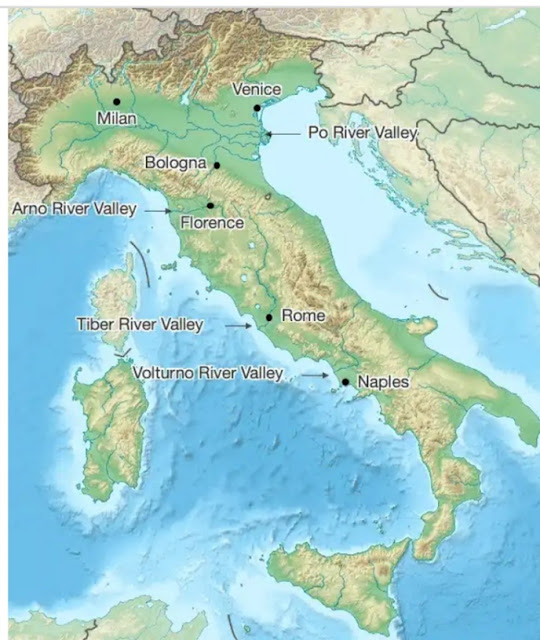
“In the past, Geography ruled History”, writes Tomas Pueyo. To some extent, most of us know that. After all, all major civilizations arose on the banks of rivers – Nile, Ganga, Indus, Euphrates…   Pueyo then gets into other aspects that, once told, seem obvious. (And yet, I’d not registered most of them). You need plains for a civilization to flourish. “Conversely, you want to avoid mountains. A 2% slope makes cultivation impractical, and above 6% it’s impossible.” But just having plains isn’t enough – they need to be fertile : “Places that are less fertile feed fewer people, so they get less population density, less specialization, and less wealth overall. With longer times to communicate and transport goods, commerce is much more expensive, and hence there’s less of it. Perishable goods are especially less valuable. Hence, again, less wealth.”   He then takes into real world examples. Take Italy:   The Blue lines are the rivers. The Green parts are ...

Central Characters of History

Stephen Davies wrote a thought-provoking article on how history is written and taught. History, he says, focuses on one kind of events – the political ones. “(It) implies that the driving force in history, the thing that shapes and determines the world we are in and that is crucial for our future, is politics and political power. The dates given are all about political power: Who has it, who contests it, and who wins it.”   An unintended side-effect of this is that it influences us, consciously or unconsciously, into “what we should see as important here and now”: “This story is of the growth and development of government, the forms it has taken, and in particular the historical evolution of particular states or political entities.”   As an alternative, he says, consider these events. The publication of Newton’s Principia Mathematica . Adam Smith’s Wealth of Nations . Darwin’s On the Origin of Species : “These are all landmarks in a quite different kind of stor...

Rhyme, not Repeat

Capitalism, in combination of industrialism, led to more and more inequality. Eventually, as Anirudh Suri reminds us in The Great Tech Game , that inequality led to a backlash and to the rise of Marxism and communism. And then communism lost favour, with the fall of the USSR.   Today, we seem to be on the cusp of history repeating itself. Well, not repeating. Rather, as Mark Twain famously said: “History never repeats itself, but it does often rhyme.”   Suri elaborates. The tech companies of today have become unimaginably rich, with the likes of Apple, Amazon, Microsoft, Google and Facebook becoming trillion-dollar companies (not a typo, that’s “trillion” with a “t”). At the same time, these companies don’t generate employment on the same scale as manufacturing behemoths of the past. They do more with far, far fewer employees. Which is why Suri worries: “As technology and capitalism combine to create some of the same structural inequalities and class conflicts, ne...

Diseases and the Americas

Have diseases shaped the course of history? Most of us know that the Spaniards brought small-pox and measles to the Americas with them, diseases that the natives had never experienced. The death toll of the diseases played a major role in what followed: the Spaniards wiped out the ancient civilizations of the Americas. In addition, as Michael Oldstone writes in Viruses, Plagues and History , since the diseases seemed to selectively kill the natives but not the Spaniards (who had experienced and survived it in Spain), the natives came to accept that the Spanish gods must be superior than theirs: why else were they dieing while nothing seemed to happen to the Spaniards? This accelerated the conversion of millions of survivors to Christianity.   Another disease, yellow fever, brought to the Americas by the white man, killed both the natives and the Caucasians . This one came via blacks who had come trading or as slaves. It turned out the blacks were far more resilient to yellow fe...

Why There is No "End of History"

There’s this concept called “end of history”. No, it doesn’t refer to the point when the world has ended. Rather, it is a phrase that is limited to some areas only: “The end of history is a political and philosophical concept that supposes that a particular political, economic, or social system may develop that would constitute the end-point of humanity's sociocultural evolution and the final form of human government.” Notice that the phrase does not mean that events will stop occurring.   In our lifetime, the period most associated with this phrase is when the Berlin Wall fell – it seemed to signify the point when capitalism and democracy had triumphed; from here on, the assumption was that only the details might change, not the basic principles themselves.   Today, while capitalism is still ruling, it’s hard to argue that democracy is still the ruling system. Several of the threats to Western ideals are external, from outsiders. In that bucket fall Is...

History, Propaganda and the Khilafat Movement

Image
In one of his articles, Tomas Pueyo wrote that: “We think we’re taught History. But we’re really taught Propaganda.” That’s one of those statements whose truth value everyone agrees with. And yet, everyone disagrees on when it is History and when it is Propaganda. (Hint: When one’s own side writes the books, people call it History; when the other side writes it, it’s Propaganda).   Propaganda comes in many forms. Outright lying is one extreme of how history is written. Another way is to withhold inconvenient facts. Or to present one’s assessment of the facts as history. Or to present historical events as a story leading upto something – as if history has a direction or purpose. And then there’s what Calvin said:   All of which is why Pueyo says: “For every truth you hold about the past, somebody else has the opposite take.”   When I was at school, they taught about the Khilafat movement during India’s freedom struggle. It never made any sense why som...

Yet Another "Use" of History

In both his books on the Mongol empire, Genghis Khan and the Making of the Modern World and its follow-up, The Secret History of the Mongol Queens , Jack Weatherford refers to something called The Secret History as a source. I always wondered why it is called “secret”. Sure, history is disputed, written by the winners, revised to suit whatever ideology is in vogue – we know all that. But “secret” history? That’s new…   Strangely, the Mongols didn’t seem to covet jewels and treasures as much as they did their documents and records! The Persian historian Rashid al-Din points out the Mongols went even further in how they maintained their records: “From age to age, they have kept their true history in Mongolian expression and script, unorganized and disarranged , chapter by chapter, scattered in treasures, hidden from the gaze of strangers and specialists, and no one was allowed access to learn of it.” Not only was it secret, it was deliberately chaotic in its organizatio...

Is History Explanatory or Narrative?

In their very short romp through history titled The Lessons of History , Will and Ariel Durant, start by flipping that famous quote and ask: “Is history “a fable” not quite “agreed upon”?” And on a related note, they ask: “As his studies come to a close, the historian faces the challenge: Of what use have your studies been? Have you found in your work only the amusement of recounting the rise and fall of nations and ideas?” Or: “Have you derived from history any illumination of our present condition, any guidance of our judgment and policies, any guards against the rebuffs of surprise or the vicissitudes of change?”   Some believe that history repeats itself. Others, like Mark Twain, believed that history rhymes, but doesn’t repeat. James Carse, in his book, Finite and Infinite Games , says there are other historians who believe that history can never be objective, that it is affected by the observer (Heisenberg would probably have agreed!). Carse then says: “The ...

History Telling Alternatives

History is usually written and described in narrative form. I heard this very interesting podcast on the pros and cons of that approach, as well as the alternatives to narrative history. But, first here’s how narrative history works: 1)     Pick a historical character, based on importance. Then make him/her the central character of the story. This is the story of kings and queens, generals and strategists, presidents and prime ministers. 2)     Base it on heroic or tragic events, or vice and virtue. This too inevitably becomes individual based story telling.   While the story feels coherent, this approach has its well-known problems. “Speedbumps” in the narrative becomes problematic e.g. a good king who does evil things. And since everyone is grey, this applies to every single instance of narrative history. Include the speedbumps and the story loses its coherence; exclude them and it appears incomplete, or worse, biased. Another issue is that narra...

Rewriting History, not Always a Bad Thing

When anyone comes up with a new narrative of historical events or paints a new picture of an important character, some look at it as a genuine attempt at revisiting the facts. Others wonder if it is just another attempt to rewrite history to suit an agenda. With events that are very old, one can never be sure what really happened. Even with more recent, better documented events, one never knows the motives behind actions: Malice? Incompetence? Greed? Ambition? Miscalculation? Or something else? Three recent incidents got me thinking about all this. The first was this Shekhar Gupta talk on some of the long-reaching and/or courageous decisions made by India’s short-term PM’s like VP Singh, Chandra Shekhar, IK Gujral and Deve Gowda. That was an eye-opener for me, because (a) I had dismissed them as inconsequential due to their short tenures, plus they felt opportunistic PM’s, and (b) “official” history only talks of the Nehru-Gandhi scions (Even PV Narasimha Rao who wasn’t “short-...

Entertaining Romp Through India's History

Sanjeev Sanyal’s Land of Seven Rivers is an entertaining romp through India’s history, with endless tidbits, and the author’s own opinion on events. The book starts off with the plate tectonics that caused the Indian landmass to break away from Africa/Madagascar and set it off on its course to its present location. Unfortunately, that fact leads many to the erroneous conclusion that it explains why India and Africa share animals like elephants and lions. But: “This cannot be the case because India separated from Africa during the age of the dinosaur.” In fact, the reality is far more weird. Thanks to DNA analysis, we know that: “The Asian elephant is more closely related to the mammoth than to the African elephant.” Sanyal talks about the tendency of kings from time immemorial to try and present their best (and not entirely true?) persona for posterity to remember them by. Take Ashoka’s famous edicts on rocks and stone pillars: “One should always take statements by polit...

No, the Winner Wasn't Known all Along

No triumph is preordained, unless one side is overwhelmingly stronger. Strike that: even then, the occasional David does defeat the Goliath. And yet, the fact that we don’t know the outcome until the fight ends doesn’t stop us from believing that the victor’s victory was preordained. And so we continue to write history as if the victor was known all along! I read this blog that cited the triumph of capitalism as an example of what many now believe as something that was inevitable all along. The blog mentions multiple examples that proves the reality of how things were really perceived while the capitalism v/s communism fight was still ongoing, even in the US: “(The US fought the disastrous Vietnam war) because it feared communism would succeed, not that it would fail – that communism could supplant capitalism… When Khrushchev spoke of “burying” and “overtaking” western capitalism, nobody laughed. The danger was a serious one. And the launch of Sputnik suggested to the world ...