Posts

Showing posts with the label governance

Why Data is Critical to Governance

In Accelerating India’s Development , Karthik Muralidharan says: “The centrality of data for governance is seen by noting that the very origin of the word ‘statistics’ comes from its crucial role in managing the affairs of the state.” But India’s data systems are outdated. They are designed to track national progress, not for supporting day to day governance. The focus is on measuring visible inputs (how many schools?) rather than harder to measure outcomes (quality of education). The actual citizen’s experience is barely measured (was the service easy or convenient?).   Even worse, any data that is gathered is by the respective departments themselves. Who have a vested interest in making themselves look good. And who may not have the right data analysis or statistical skills anyway.   The lack of investment in our measurement infrastructure thus has many consequences: (1) money is spent on the wrong policies, (2) a focus on easily measured inputs instead of ha...
How the Role of Western Governments Evolved

Most of us never learnt Western history from a social perspective – how, for example, did the Western welfare state emerge? Prof. Karthik Muralidharan looks into that in his book, Accelerating India’s Development .   Long, long ago, Western governments monarchies were about one thing only – security. After all, it was a time when your neighbor could attack, defeat, loot and occupy you, and enslave or kill your inhabitants. Those were savage times.   The role of the Western state changed only with the Industrial Revolution. As production increased phenomenally, better systems were needed. Roads, ports, railways initially.   As urbanization followed industrialization (people migrated for better paying jobs from the villages), the populations of towns exploded. Sanitation and sewage systems had to be improved. These improvements in turn boosted productivity and the state’s tax revenue, which could further improve infrastructure (and yes, continue to fund the militar...

Does India Need More States?

Image
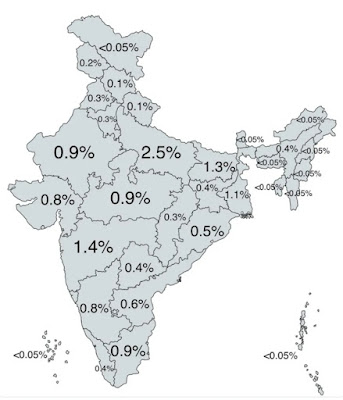
Some guy tweeted a pic that captured the fraction of the world’s population ( not India’s population, but the entire world’s) living in each state of India: While most of us wouldn’t have known the actual percentages the way the map shows it, overall, it is hardly surprising to most Indians.   Pranay Kotasthane drew an interesting inference from the map. Taking UP as the example, he points out: “There’s no way an Indian state government with current levels of capacity can provide for 2.5% of humanity. ” He added another very relevant comparison: “UP, for example, is twice as populous as China's most populous province, Guangdong.” Therefore, he says: “We probably need twice the number of states as we currently do. ”   He then takes an interesting digression into the basis on which the states were created at independence. Yes, on linguistic basis. On that: “(BR Ambedkar ) made the critical distinction between “one language, one state” and “one state, one ...

Rome and Us #1: Governance

While reading Mary Beard’s SPQR on ancient Rome, I was struck by how almost all of Rome’s problems and solutions to the problem called governance are still there even today. In 2,000 years, have we solved and improved nothing?   Within 2 centuries of its founding, Rome had (unbelievably) gotten rid of not just a particular king, but the very idea of a king itself. Monarchy was replaced by “liberty” and the “free Republic of Rome”. Here’s how Rome defined a Republic: “Two central tenets of Republican government were that office holding should always be temporary and that, except in emergencies when one man might need to take control for a short while, power should always be shared.” The dislike towards the idea of a king was deeply entrenched: “To be accused of wanting to be rex (king) was a political death sentence for any Roman; and no Roman emperor would ever countenance being called a king, even though some cynical observers wondered what the difference was.” Even J...

The Governance of Platforms

Platforms (e.g. Facebook, YouTube, Amazon, Android, Flipkart, Uber, Swiggy) have to juggle conflicting needs, write the authors of The Business of Platforms . On the one hand, they want more and more people on their platforms. They also want those people to add value (e.g. by posting more material, writing more apps etc). On the other hand: “(They aim at) minimizing low-quality transactions, such as weeding out low-quality goods and services, facilitating return in case of unsatisfied customers, and fighting fraud.”   But if they go too far on the latter, they are accused of censorship (Facebook, Twitter, YouTube). Don’t do enough and they are accused of allowing everything – counterfeits (Amazon), porn (YouTube), and fake news (Facebook).   The authors call this fine balancing act as “platform governance”. It gets even more complicated and messy when the platform tries to sell/promote its own products. That raises accusations of conflict of interest. Examples includ...

Data and Governments

By definition, any statistical analysis is based on data. Setting aside genuine errors (wrong sample size, unrepresentative sample set, wrong questions asked), Tim Harford talks at length about the problem of data used by governments, in his book, How to Make the World Add Up .   As we know all too well, data can be misleading, even without malice. With governments though, the danger of such wrong data is enormous: “It’s one thing to be wrong… (but) because the state is powerful, its misperceptions of the world often take physical form, producing well-meaning but clumsy and oppressive schemes.”   But of course, with governments, the problem is worse. They often pressurize agencies to come up with data that suits them. I’ll avoid such examples from India since that just becomes a political discussion in no time.   Independent agencies are not a magic bullet that solves the problem: “(Independent) official agencies often get them wrong… (just that) they don’...

Blaming Politicians

Everybody tends to curse politicians. Many of the reasons are valid, of course. But politics is the art of operating within the bounds of what’s possible. Or as Barack Obama said : “I used to explain to my staff after we had a long policy debate about anything, and we had to make a decision about X or Y, “Well, if we do this I understand we’re not getting everything we’re hoping for, but is this better?” And they say yes, and I say, “Well, better is good. Nothing wrong with better.” That’s a point most of us understand and agree with in our calmer moments.   Unfortunately, we’re rarely calm when we think of politicians or policies. Instead, we’re almost always in an antagonistic mindset. So for the same outcome, we think differently based on who’s in power. His political opponents won’t let my guy do the good he wants to. The other guy never intended to do any good anyway. My guy did the best anyone could have done. Your guy sold out.   The passage below by Ib...

More Lessons from Machiavelli

A few months back, I had written about the positive side of Machiavelli’ism . More recently, I read this article by Michael Ignatieff , who pointed out that when it comes to Machiavelli’s book, The Prince : “The outrage has not dimmed with time.” This is one of those hidden in plain sight questions: why is the book still considered so relevant today? Doesn’t every politician pretend they are un-Machiavellian? And isn’t it true that every citizen “knows that politics is one of those realms of life where you put your soul at risk” ? Michael Walzer, a Princeton philosopher, once said: “We want our politicians to be…lying awake at night, wrestling with the conflict between private morality and the public good.” Modern thinkers call this the “problem of dirty hands”. Machiavelli’s take on that? Don’t think about it! “He believed not only that politicians must do evil in the name of the public good, but also that they shouldn’t worry about it.” Because: “In politics, the...