Posts

Showing posts with the label teaching

Is Personalized Teaching a Possibility?

A common complaint about schooling is that different students are at different levels, but the class proceeds at the same pace and style for everyone. I’d always felt this is a stupid complaint, because how on earth can a teacher customize things for every child? But now after reading about Mindspark , I wonder if computer aided teaching can address that complaint. Here are its 4 main features: 1)       It has more 45,000 test questions that evolved iteratively over the years. 2)      “Teaches at the right level” by starting with an initial diagnostic test and then adjusting based on student performance on each subsequent activity. 3)      “Adaptive in approach”: Essentially, this address the problem that different student may struggle for different reasons, for example : “If a student makes a mistake on which decimal is bigger (3.27 or 3.3), it may be due to “whole number thinking” (27 is bigger than 3) wher...
Art Wars: Science the Casualty

Image
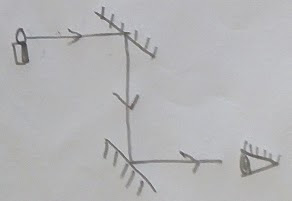
I'd bought this science kit for my 6 year old, using which she could make a periscope and a pin hole camera (Sorry, kiddo, this is what you get when both parents are engineers!). She likes to build such things – sometimes as something to play with, and always as something to brag to her friends. Of course, not satisfied with this, I insisted on teaching her how a periscope works. By drawing a pic of how light reflects off the angled mirrors of the periscope: Unfortunately, the lesson was lost in what followed: She : “What is that thing you’ve drawn at the bottom? ” Me : “An eye. Of the person who is viewing through the periscope. ” She : “Humph… you don’t even know how to draw an eye. ” Me : “Oh yeah? Like you can draw any better. ” She : “Of course I can.” To prove her point, Ms.Michelangelo drew some eyes for me: Were her drawings good? Sure, but I was not going to be distracted by art in a science lesson. But also, I also got why she thought my d...

Watching Out for the Clever Hans Effect

During her summer holidays, I tried teaching carryover and borrowing (in maths) to my daughter. Like everyone else, she picked up carryover easily. But borrowing proved a harder nut to crack (no surprise there either). I’d be sitting next to her as she practiced and at one point, it looked like she had learnt borrowing too. A couple of days later, I wrote down a couple of subtraction questions and stepped away to attend to a few other things. When I returned, I found she had made many mistakes in subtraction/borrowing. What had happened? How could she have forgotten given that she was practicing every day? Then I remembered this horse called Clever Hans. In the late 19 th century, Wilhelm Von Osten started teaching his horse to count by tapping his hooves. Amazingly, the horse could soon do many maths problems, including fractions, multiplication, even working out dates! Sure, he wasn’t always right, but the accuracy rate was high enough for Germany’s board of education to take ...

What's 5 x 3?

Image
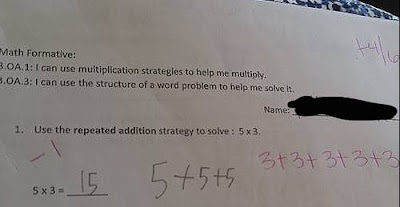
Recently, the grading of this answer sheet went viral on the Net.  The issue? For the question, what is “5 x 3”, the kid had solved it by calculating “5 + 5 + 5” but the teacher marked it Wrong indicating the correct way to solve it was by calculating “3 + 3 + 3 + 3 + 3”. What’s the difference, the Internet screamed. I agreed. In fact, I had written a blog on a similar topic a year back based on Richard Feynman’s comment in The Pleasure of Finding Things Out : “The whole idea was to find out what x was and it didn’t make any difference how you did it–there’s no such thing as, you know, you do it by arithmetic, you do it by algebra.” Of course, this being the Net, you can find a counter argument (if you choose to look). Sure enough, I found a good one by Brett Berry as to why the teacher may be right after all: “In the above problem 5 x 3 is equal to 5 + 5 + 5, but they’re not necessarily equivalent.” Huh? Another example from Berry makes the difference between...

Teaching Techniques

One of the students of an English professor, Alan Jacobs, once asked him: “You mean that the stuff we learned last semester applies in this course, too?” Isn’t that exactly how most of us went through college, semester by semester, never feeling there was any connection between any two things, never seeing any big picture to all the courses? Even if we set aside a 3 or 4 years course as too long and having way too much content to come together, can individual college courses at least be taught better? Harvard art history professor, Jennifer L. Roberts, thinks this is one way to go about it : “During the past few years, I have begun to feel that I need to take a more active role in shaping the temporal experiences of the students in my courses; that in the process of designing a syllabus I need not only to select readings, choose topics, and organize the sequence of material, but also to engineer, in a conscientious and explicit way, the pace and tempo of the lear...

Right Technique, Wrong Subject

Image
I read this post by a maths school teacher, Brooke Powers titled “Who or What Broke My Kids?” . After teaching the basics of probability, she went into a school book prescribed exercise where probabilities were expressed as decimals, fractions, percentages and words (“likely”, “improbable”) and the students had to sort them in ascending order of probability. So what happened? “It turned into a ten minute nightmare where I was asked no less than 52 times if their answers were “right”.” And why did that happen? “My students truly believe for some reason that math is about combining whatever numbers you can in whatever method that seems about right to get one “answer” and then call it a day…Today they were given a task with no real correct answer and they lost it.” Highly irritated, Powers called for a break: “We talked about the need for them to stop worrying about if I think their answer is right and to start worrying about whether or not they thought their answer was righ...

The Case for Mental Models

Sherlock Holmes asked Watson in A Study in Scarlet : “What the deuce is [the solar system] to me? You say that we go round the sun. If we went round the moon it would not make a pennyworth of difference to me or to my work.” Continuing in that vein, Holmes even announces his intent to unlearn this bit of information, “I shall do my best to forget it”. Are Holmes’ remarks the reason why even very knowledgeable teachers struggle to teach their students? Because the student is thinking, “So? What do I do with that new bit of information you hurled at me?” After all, most people think of teaching the way Nobel-Prize winning physicist and professor Carl Wieman started: “When I first taught physics as a young assistant professor, I used the approach that is all too common when someone is called upon to teach something. First I thought very hard about the topic and got it clear in my own mind. Then I explained it to my students so that they would understand it with the same clarity I...