Posts

Showing posts with the label elections

Ranked Choice Voting (RCV)

As mentioned earlier, India’s first-past-the-post (FPTP) system leads to bad governance. To recap Karthik Muralidharan in Accelerating India’s Development , FPTP incentivizes governments to focus on the sub-groups who are “enough” to win elections instead of trying to deliver for everyone.   One alternative to that is called ranked-choice-voting (RCV). The idea is that voters rank candidates in the decreasing order of their preference (They can rank as many as they want, not necessarily all the candidates). “If a candidate wins over 50% of first-choice votes, they win. If not, the lowest-ranked candidate is dropped and the votes of those who ranked them first are transferred to their second-choice candidates. This process continues until a candidate receives over 50% of the votes.” An example helps. Say, there are 3 candidates, A, B and C who gets 36, 34 and 30 votes. C got the least, so he is dropped. The second-preference of the 30 votes for C are checked. In this case, s...
Contradictory Signals

Raghu S. Jaitley makes an interesting observation about the upcoming Lok Sabha elections. On the one hand, almost everyone says “it appears like the most pointless LS election in living memory”. The BJP’s victory appears to be a foregone conclusion (Modi talks of winning 400 seats), and the opposition seems to be in disarray with endless arguments over seat-sharing arrangements. “It is either the failure of the political imagination of the opposition leaders or the relative success of this government that we might not have any overarching theme that serves as the connective tissue to the multiple state or local issues.” Which is why Jaitley says: “While I can foresee lots of drama and rhetoric in campaigns at the state level, this will be a ‘no wave’ election, which means it will be impossible to dislodge the incumbent.”   And yet, there are other signs and actions of the BJP that “belie this optimism”. “The eagerness to stitch alliances across states and political spe...

Changing the System

Shivam Shankar Singh’s book, How to Win an Indian Election , looks at attempts to change the political system. He cites the experience of Irom Sharmila, the human rights activist from Manipur who had fasted for 16 years against army atrocities: “Seeing that her fast had failed to achieve anything other than international awards and media coverage, she decided to… contest the state elections.” She got just 90 votes. Yes, just 90. Not a typo: “It was disheartening to realize that people who had dedicated their lives to serving others did not even get votes from the people whom they directly helped.” Ouch! Perhaps it was Sharmila’s political inexperience that was the problem? Singh next looks at Prodyut Bora from Assam. He was a part of the BJP, but quit it to form a new party, LDP. He had been on the inside of how elections work, and tried to factor for it. How did he fare? The lack of money led to a crushing defeat: “(It) was a case study in why new idealistic parties d...

The Sequel is an Even Bigger Hit

Image
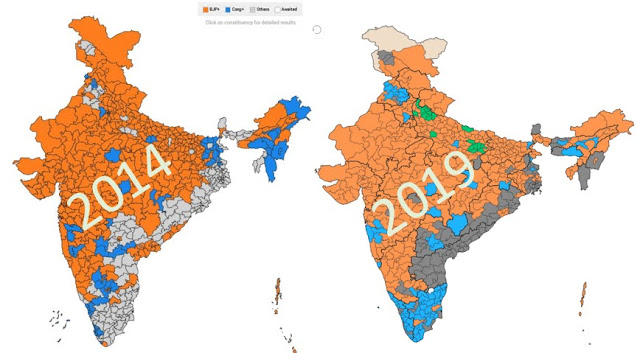
For once, the exit polls got the big picture right. Modi won, and the BJP got an absolute majority. There were surprises too. Like the BJP getting an even bigger absolute majority than last time. The BJP’s vote share rose from 31% last time to 41% this time despite a massive ganging up of all parties in pre-poll alliances. Rahul Gandhi lost in Amethi. Fortress Bengal was breached big time. See the maps below of who won where in 2014 and 2019. Whatever the BJP lost this time in Andhra/Telengana, it more than made up via the gains it made in the North East, West Bengal and Odisha. Mihir Swarup Sharma writes of the origin of the Congress’ “Idea of India”. At independence, especially after all the bloodshed of Partition, Nehru decided: “India is a bundle of contradictions, of competing group assertions, and it is the duty of the Indian state is to play an arbiter between them, to cover up and manage these centripetal and divisive forces through inclusion, representation and...

A Murky Story

As Facebook got caught in (yet another) storm over privacy, this time over a firm called Cambridge Analytica, we have the usual polarized views being blared out: -          Was the Facebook data leaked? Or misused? -          Did it contribute to Trump’s win (and Brexit)? -          How much is Facebook to blame? To answer those questions, we should see what exactly happened. Cambridge Analytica is a data analytics firm. Depending on your political views, writes Bryan Clark , it was: “either integral to the Brexit leave campaign and Donald Trump’s surprise presidential victory, or selling snake oil that both parties (and others) willfully swallowed.” The firm was created by an American billionaire, Robert Mercer, a staunch Republican, to mine data for political purposes. If you are horrified, remember that Facebook, Google and Amazon target ads at yo...

Good Sign for the Future?

Image
As the results of the state elections came out on Saturday, the one that garnered all the attention was UP. Obviously. How could a state considered impossibly complicated with its castes, sub-castes and religious divide yield such a landslide outcome to any one side? And yet, Amit Shah has done his magic twice, during the Lok Sabha elections and now. Amazingly, the BJP did not field a single Muslim candidate in UP! So was this a “majority vote against a minority veto”? Has the Modi-Shah combo nailed the numbers perfectly to become the “Hindu mascot” without “running after the minority votes”? Is the Muslim vote bank on whom all of the opposition relies no longer sufficient to win? Has “sickularism” finally gone so far that the majority has begun to assert itself? Or is it also because Modi, the orator, promises growth, progress and jobs while the opposition only plays to the fear of the minorities without offering anything positive for anyone? If this is a trend that is here...

Social Media and Elections

Nick Carr wrote an article about how every new communication medium forces political candidates to adapt and often changes the very nature of campaigning . In the 20 th century, it first happened with the advent of radio: “Politicians, used to bellowing at fairgrounds and train depots, found themselves talking to families in their homes.” Next came TV: “TV placed a stress on sound bites, good teeth and an easy manner. Image became everything, as the line between politician and celebrity blurred.” And now, he laments, comes social media. With that, “political discourse is shrinking to fit our smartphone screens” via the apps of Facebook, Twitter, Instagram and YouTube. Further, the very nature of the political candidate is changing, he says: “If traditional print and broadcast media required candidates to be nouns—stable, coherent figures—social media pushes them to be verbs, engines of activity. Authority and respect don’t accumulate on social media; they have to be earn...

How to Win a Majority

Image
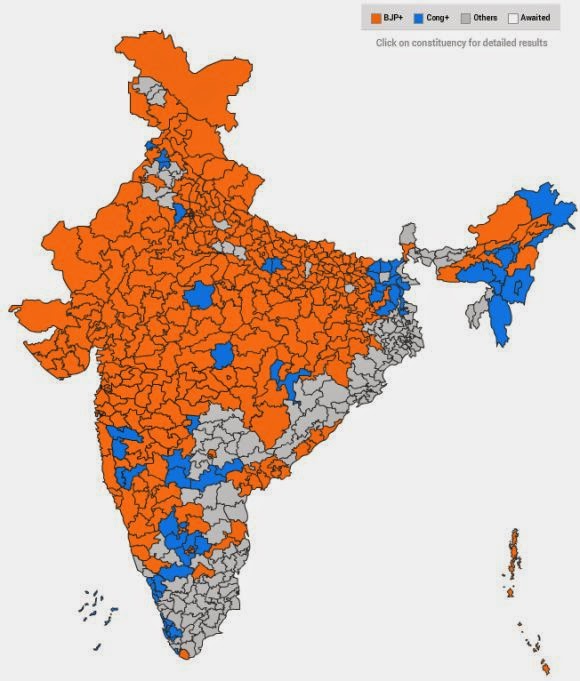
There is a sea of orange in the map below, indicating the seats the BJP won in the just concluded elections: A lot of people were curious as to the vote share of the BJP nation-wide. Did they win a proportional number of votes? Or did they just get votes in places they won and did not have any “wasted” votes? (Here, a “wasted” vote is one cast in an electoral district where the party did not win). Equally, was the return of a single party majority a sign of the end of regional parties, at least at the national level? Was this the beginning of the move to a two party system? Good questions. Surprisingly, the first answer I saw to these questions was in the Washington Post by a non-Indian guy named Adam Ziegfeld ! So what are the answers? The BJP’s vote share this time was just 31%. In contrast, the Congress despite getting decimated got 19%. It was the distribution of votes that mattered: the BJP hardly had any “wasted” votes. To understand how “useful” every BJP vote w...

The Need to Find a Reason

As the election results started rolling in on Friday, it was amusing to see the news channels provide “reasons” for the wins and losses, close margins and landslides. Why did Jayalalithaa win? 2G scam and corruption. Really? Since when did Jayalalithaa become the poster girl for the opposite of corruption? Or why did Mamata win? General misrule by the Left. Really? It took 20 years and multiple elections after liberalization to figure out that the Leftist approach was taking Bengal nowhere? Of course, this kind of insane reason providing doesn’t stop at the elections. We hear similar rubbish about why the Sensex fell or rose (the Euro crisis; the signs of an American recovery; RBI’s interest rate hikes). Isn’t it more likely that the market fluctuates because investors aren’t rational? With rational investors, we’d never have stock market bubbles and crashes, would we? Even religions/philosophies insist on providing a reason: why do some people suffer? Why did so many die during the ts...