Posts

Showing posts with the label result

Intention Heuristic

Heard about the “intention heuristic”?  Let Arnold Kling explain what that means: “The intention heuristic says that if the intentions of an act are selfless and well-meaning, then the act is good. If the intentions are self-interested, then it is not good.” Put simply, the intent behind an action is more important than its consequence . The intention heuristic probably explains why so many people who genuinely want a better life for everyone dislike capitalism. Because the intention of capitalism isn’t to make everyone better off. That is just a consequence . The benefits of Internet connectivity are enormous and obvious to people like us. Yet, many criticize Facebook for its attempt to bring free access to a small subset of that very same Internet to the remote and/or poor for free. Why? Because the ultimate motives of Facebook is to make money from the next billion that comes on the Net. In other words, the intention heuristic. If Facebook aims to make money, it’...
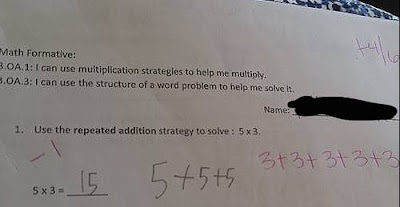
What's 5 x 3?

Image
Recently, the grading of this answer sheet went viral on the Net.  The issue? For the question, what is “5 x 3”, the kid had solved it by calculating “5 + 5 + 5” but the teacher marked it Wrong indicating the correct way to solve it was by calculating “3 + 3 + 3 + 3 + 3”. What’s the difference, the Internet screamed. I agreed. In fact, I had written a blog on a similar topic a year back based on Richard Feynman’s comment in The Pleasure of Finding Things Out : “The whole idea was to find out what x was and it didn’t make any difference how you did it–there’s no such thing as, you know, you do it by arithmetic, you do it by algebra.” Of course, this being the Net, you can find a counter argument (if you choose to look). Sure enough, I found a good one by Brett Berry as to why the teacher may be right after all: “In the above problem 5 x 3 is equal to 5 + 5 + 5, but they’re not necessarily equivalent.” Huh? Another example from Berry makes the difference between...

Process or Results

In Thinking, Fast and Slow , Daniel Kahneman has this to say about “outcome bias”: “We are prone to blame decision makers for good decisions that worked out badly.” He says we forget that what appears obvious with hindsight “was written in invisible ink that became legible only after the event.” That part of the invisible ink, Nassim Taleb (of The Black Swan fame) would dismiss as “narrative fallacy”: our inability to attribute things to luck (or randomness); which in turn makes us come up with well defined reasons, events and choices behind whatever it is we saw happen. (On a related note, maybe this is why we never learn from history? Does narrative fallacy do exactly what Taleb warns about: “It severely distorts our mental representation of the world”?) Most of us, in our rational moments, think that we should value process over results. Because we believe that over time, the luck aspect will even out, and the better process will triumph more often. Here’s the ...

Where Chaiwallahs Can Be PM

In the end, the exit polls were wrong: It wasn't the NDA that scraped past the half way mark, it was the BJP that single handedly got the majority! The absolute majority has robbed the media of the usual next stage of an election: who will align with whom? What will they demand in return? What impact will it have on a cohesive agenda to govern? All moot points now. We don't need to suffer your blackmail tactics, amma and didi . To those who bemoan the rise of the “communal” leader, Harsh Pant has the answer : “(Narendar) Modi is a product of contemporary India, where the secular versus communal binary, while important, is no longer the be all and end all of politics.” Besides, let's face it: we have had a communal party in power for most of the period since 1984 anyway: the Congress killed 3000 Sikhs in 1984. While Bal Thackeray made the remote control model of governance (in)famous at a state level, madam and baba took it to the next level, the national leve...