Posts

Showing posts with the label physics

Nazis and the Physics Connection

When the Nazi government seized power, they started removing Jews from more and more positions, including the civil services, and the science departments of Germany. Those physicists who saw the writing on the wall fled to either UK (like Schrodinger) or the US (like Einstein), writes Adam Becker in What is Real?   The great physicist, Enrico Fermi, wasn’t a Jew. But when Mussolini aligned with Hitler, Fermi came under suspicion since his wife was a Jew. To make matters problematic, Mussolini’s new laws had made it illegal to take “more than pocket change” out of Italy. Neils Bohr broke an unwritten rule of the Nobel and told Fermi that he (Fermi) was in the running for the Nobel that year. Perhaps Fermi, should he win, could consider escaping from Stockholm with the prize money to start a new life? Fermi agreed, but it was touch and go – his wife’s passport had been confiscated, which meant she couldn’t come to Stockholm. Fermi managed to pull a few strings to get her passport...
Maths and Physics #5: To Present Day

It is one thing for patterns of overlap and relevance to emerge between physics and maths. But to make the actors in the two fields actively work with the belief that work in one can yield insights into the other, that is a different thing altogether. For the latter to happen, you need someone very charismatic, very persuasive, someone “inclined to whip up enthusiasm for wild ideas”. The mathematician, Michael Atiyah , was just that guy.   He convinced (math) geometers and (physics) gauge theorists that they were working on the same subject, just from different perspectives. Subatomic physicists were surprised that a very hard problem in their field could be solved using a maths theorem that connected topology and calculus. So much was the overlap that the Wu-Yang dictionary was created to enable physicists and topologists to talk to each other! In fact, repeatedly, both sides found advances or a new theory in the other field gave insights into questions on their side. “The...

Maths and Physics #4: The Long Divorce

At the end of World War II came the “ long divorce ” of physics and maths. Physicists only worked with well-established maths; and mathematicians had no interest in physics. Neither side looked to advances in the other field for new ideas or seeds that might be relevant to their own fields. Why had this happened?   Part of the reason was that mathematicians feared that their field was becoming a “ragtag of unconnected ideas and results”. Kurt Godel’s theorems had struck a dagger at the very heart of maths – maths seemed to be in tatters. Best for mathematicians to decide how their field could proceed, they felt. Another reason was that physicists found they were able to make progress with existing maths. And lastly, applied physics was in vogue, esp. solid state physics. The engineering mindset – approximations were acceptable as long as they worked – was becoming the norm. This, of course, made theoreticians in both physics and maths wary, uncomfortable and even contemptuous o...

Maths and Physics #3: Dirac's Influence

The next part of the physics-maths story starts with quantum mechanics. When Heisenberg tried to explain things, he ran into mathematical array with strange properties. To him, they were strange. Mathematicians, however, had known it for long by the name of array matrices .   Dirac entered the quantum mechanical story late. He was more mathematician than physicist. When he investigated Heisenberg’s and Schrodinger’s equations, he “bent the rule of mathematics”. He made extensive use of a “mathematical function that made purists blanch”. Dirac didn’t care. If the physics worked (as quantum mechanics did), then any mathematical implication of it, however weird it may seem, must be true, argued Dirac. Dirac was reversing the directionality – so far, maths had helped physics; but now Dirac was saying physics could lead to new maths too. Oh, that function that made purists blanch? Decades later, other mathematicians would prove the function was correct.   Dirac wasn’t do...

Maths and Physics #2: Back to Greece

Max Planck is known as the founder of quantum theory. He came up with the idea of the quantum as “an act of desperation”, to explain weird experimental observations that could not be explained by theory. He found he could explain the observations “only by butchering the mathematics of the underlying theory”, by assuming the existence of “quanta”. But to him, quanta were just mathematical constructs, not real-world constituents.   Albert Einstein , in trying to explain the photoelectric effect, concluded that the energy of light (and all electromagnetic waves) was quantized. Quantization was real, argued Einstein, not just a mathematical convenience.   Many had noted that Maxwell’s laws were “symmetrical” in certain mathematical ways. Einstein went further than others. Not just Maxwell’s laws, he said, (mathematical) symmetry applies to all universal laws of nature . Conversely, he said, if a universal law isn’t symmetrical, it’s wrong. So far, all experiments show th...

Maths and Physics #1: Early Period

You can’t do physics without maths. It’s been that way since Newton. But has it gone too far, many have asked, to a point where physicists fall in love with “beautiful” mathematical theories and stop caring if it aligns with the real world? Phrases like “fairy tale physics”, “not even wrong”, and “lost in math” capture that sentiment.   Farmelo Graham’s book, The Universe Speaks in Numbers , traces the history of the relation between physics and maths. The story starts with Newton ’s theory of gravity – the equations matched observations, but, complained the critics (even back then), it didn’t describe the physical mechanism behind gravity. This was also a case of Continental envy – the British worshipped Newton, while the Continent felt he was a mathematician, not a physicist.   A generation later, the roles reversed. Frenchmen like Laplace advocated and advanced physics via maths, while the British dismissed such an approach as “flowery regions of algebra”. Not jus...

Spherical-Cow Philosophy

There is this joke about a dairy farmer wanting to maximize his cow’s milk production. So the farmer goes to a physicist who comes back with a stack of impressive looking equations and says, “Well, first assume a spherical cow…”   At first sight, it just sounds like yet another theoretical simplification to the point of absurdity. But there is a lot to this “spherical-cow philosophy”, writes Sean Carroll in The Biggest Ideas in the Universe 1 . Specifically in how physics is done: “Idealize a difficult problem down to a simple one by ignoring as many complications as you can. Get an answer to the simple problem. Then put the complications back in and calculate how they affect the answer to the simple problem.”   Physics is famous for this method e.g. ignore friction, build an idea, then add friction into it. For no apparent reason, this technique works in physics. Even though it obviously does not work in so many other fields: “In fields like biology and economic...

The Standard Model... and Beyond

Image
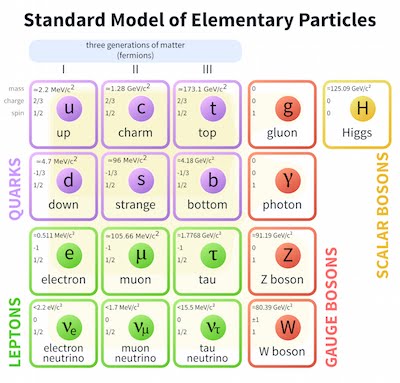
Elias Riedel GÃ¥rding wrote this short and sweet article describing the particles that make up the Standard Model of physics. At school, most of us thought that list consisted of electrons, protons and neutrons: “But atoms are not the end of the story… Protons and neutrons are themselves composed of tiny constituents called  up-quarks  and  down-quarks  (a proton consists of two up-quarks and one down-quark, a neutron of one up-quark and two down-quarks).” Ok, is there anything in the universe not made of electrons and quarks? There’s one answer that is familiar to most people: light. And it is made of photons. With photons, are we done with the list of all particles then? Nope: “We have discovered a whole slew of them (other particles) in cosmic rays and in particle colliders.” Here is where things stand today: “After much head-scratching, it has turned out that they are all different combinations composed from a small set of particles that are – as f...

Even Nuclear Detectors Need a Day Job!

Particle accelerators (like the famous Large Hadron Collider that found the even more famous Higgs particle a couple of years back) are ridiculously expensive. The Large Hadron Collider cost a jaw-dropping $9 billion (no, that’s not a typo)! How does anyone justify spending such huge amounts to learn more and more about even more obscure topics of physics that (let’s face it) most people neither understand nor care about? After all, what are the odds of ever discovering a new principle due to these detectors that would have any commercial application that would recover the money spent? Kate Scholberg, a scientist, has a partial answer. Talking of detectors built to check out particles emitted by a supernova (that’s when a star blows up, literally): “Your detector has to have a day job while it awaits a supernova.” In other words, do something besides what it was built for. Far removed from aims like understanding the universe, we have detectors to check far more earthly c...

Physics Meets Economics

In response to my blog on how George Soros made a billion in a day , my dad had posted his comment including the following line: “Economics is too much for me! I find even the most advanced physics a lot easier!!” My dad must be the rare person from the physics domain to say that. Sheldon's (of The Big Bang Theory TV series fame) response when asked by Penny if he knows economics is representative of how most physicists talk about other fields: “I'm a physicist. I have a working knowledge of the entire universe and everything it contains.” Hell, there's even an interdisciplinary research field called econophysics ! The term was coined by Eugene Stanley, to describe the large number of papers written by physicists in the problems of (stock and other) markets. You can imagine how deeply physics has tried to “infiltrate” economics by the fact that there are even terms like classical economy, quantum economy and quantum finance! (But before you get too carried away...

What’s Common to Magic and Physics?

I saw an episode of The Magic of Science on TV, a show where they use science for some of their tricks. I’ve never enjoyed learning how a trick is done; but to know when science is behind the trick…boring! On the other hand, I did enjoy Alex Stone’s book, Fooling Houdini . Stone is a physicist who starts dabbling in magic, and his comments on the parallels between the two fields were highly entertaining. For starters, he says: “There’s something deeply liberating about letting go of the reins that couple cause and effect, the X and Y axes.” Or as Stone’s guru, Wes James puts it: “Magic is not about selling your prowess. It’s about the effect you create – a profound violation of the natural laws of the universe.” There’s a trick in magic called the Ambitious Card trick that goes like this: Someone in the audience picks a card, signs it and inserts it into the middle of the deck. The magician then makes the card come to the top of the deck. I loved Stone’s analogy f...

Physics or Stories?

God said, “Let there be light!” Then scientists like Newton, Faraday and Young started studying light. And finally came Maxwell, who proved that light is not limited to what we can see...it extends far beyond in the electromagnetic spectrum. And that is the starting point for Philip Ball's article titled provocatively, Why Physicists Make Up Stories in the Dark . He starts by saying Maxwell's discovery shifted “the whole focus of physics...from the visible to the invisible”! Physics today has “not only unseen force fields and insensible rays but particles too small to see even with the most advanced microscopes”. While that may sound like a belief or something based on faith, it is supported by the facts: telescopes today use “radio waves, infrared radiation, and X-rays”. And it was kind of funny that X-rays “not only were invisible but revealed the invisible (bones under the flesh)”! Then came quantum mechanics. While the maths behind it was unquestionable, it le...

One Thing Leads to Another

My dad is hugely interested in physics. (He keeps telling me that he used to be interested, but not anymore. But that’s another story…). Unlike Rutherford who called other fields “stamp collecting”, my dad doesn’t have contempt for other fields. But I wonder whether even with his non-Rutherfordian worldview, my dad knew how totally unrelated fields drove physics even in the last century. Everyone can imagine how somewhat similar fields like chemistry could influence physics, but geology? Or paleontology (remember Ross from Friends ? The field of fossils and dinosaurs)? How could they possibly have pushed the boundaries of physics? But influence they did. It all started when people tried to compute the age of the earth a couple of centuries ago. As geologists started analyzing layers of rocks, they could not assign values to the ages of any of these layers since there was no known method to do so at that time. Then a renowned physicist got involved in the effort: Lord Kelvin...

When Physics Met Geology

C14 dating, as mentioned in my last blog , is based on carbon. Which means, as we learnt at school, it can only be used for dating organic materials. How then are does one find the age of inorganic (non-Carbon) materials? Like the age of the earth, for example? That makes for an interesting tale. One always associates radioactivity with terrible things like cancer, nuclear bombs and Chernobyl. And yet, it was the principle of radioactivity that helped figure out the age of the earth! Radioactivity is the decay of one element into another, along with the emission of the catastrophic radiation. The rate of decay for different radioactive materials is fixed. That property means radioactive materials can be used like clocks. The idea was simple: uranium decays into lead. So if you found the ratio of uranium to lead in really, really old rocks, you could derive the age of the earth. The devil lay in the execution of the idea. How do you find uncontaminated really, really old ...