Posts

Showing posts with the label software

When Opportunity Knocked...

Harish Mehta writes the story of the Indian IT industry in The Maverick Effect . In the beginning, the common problems of the industry were far too many and seemingly insurmountable.   Back then, brand India was a major problem. We were still considered a dirt poor country of snake charmers. Socialist. License raj. Pathetic product quality. “Against the backdrop of a poor nation on the brink (of bankruptcy), Indians were standing in American boardrooms, making lofty promises to help them conquer their most complex, technological challenges.” No wonder the pitches rarely succeeded in winning any projects. Even worse: “How to you help a nation-wide scatter of companies that suffer from the West’s reluctance to put ‘India’ and ‘software’ in the same sentence?”   The answer came in the form of a problem that nobody in the West wanted to work on. Yes, the Y2K problem (Older computer system stored the year in 2 digits. Come the year 2000, the last 2 digits of the curre...

Shammi Kapoor, Undersea Cables and IT

Image
This blog is based on two interesting titbits from Harish Mehta’s The Maverick Effect . ~~   A surprising cameo in the NASSCOM story is the actor, Shammi Kapoor. Even though he was in his 70’s, he was connecting to the Internet (long before the Internet took off in India) to access world news. “He was an Internet enthusiast with an incredibly curious mind. He took to new technologies like a fish to water.” NASSCOM tried to enlist him to pitch the benefits of the Internet in India to bureaucrats and policy makers in government. He agreed to do it. For free. His celebrity status was a big attraction. He spoke passionately of the world it could open up, how he connected to his kids abroad via the Internet. “His personality and presentation skills helped us communicate the potential of the Internet to even bureaucrats.” ~~   In the 80’s and 90’s, there was the huge problem of terribly slow data links from the West to India. Even the laughably slow 64 kbps link co...

The NASSCOM Story

NASSCOM (National Association of Software and Service Companies) is a trade association. It started by serving the needs of the still-in-infancy software companies, but has expanded to include BPO’s, R&D centers, and startups. “(NASSCOM is) India Inc brand builder, a think tank, a lobbyist group, an interventionist or more.”   This may sound like a reviled lobbying and backroom dealing entity, but as Harish Mehta writes in The Maverick Effect , back in 1988 (when NASSCOM was founded), it was a necessity. “NASSCOM was incubated at a time when it was an uphill battle to even get software recognized as a tangible product or a service, and something different from computer hardware.” Hard to even imagine such a confusion today…   Back then, the Indian body representing software companies was really a body for computer hardware companies, MAIT. MAIT treated software as the poor cousin. Mehta and a few others wondered if the only way was to form a dedicated body to...

Tesla #4: Suppliers and Software

When Tesla started off, there were no battery manufacturers who had either the reliability or the volumes (quantity) needed for a niche electric car wannabe (like Tesla), let alone one with mass market ambitions (delusions?). The supply chain then was yet another challenge Tesla faced, writes Tim Higgins.   Early on, one of its lithium-ion battery suppliers, LG Chem, sent it a letter with a dire demand: Return our batteries. Why? There had been several high profile issues with lithium-ion batteries – one incident involved a fire on a cargo plane (a different manufacturer); another was Apple’s recall of 150,000 laptops (batteries by LG Chem). After those incidents, LG Chem’s legal department was worried that the any fire in a car would bring lawsuits on LG Chem as well.   Tesla’s assumption that it would create the market and therefore new battery suppliers would join in was proving to be wrong. The reason for the lack of interest was the same as LG Chem – the fear o...

Security Issues in Software

Systems getting hacked. Ransomware. (Computer) viruses. Why are these so commonplace? Marc Goodman has a pretty good answer(s) in his book, Future Crimes . A lifetime ago, computers weren’t everywhere; nor was the Internet. While all that has changed, the Westphalian system of sovereignty hasn’t. What’s that? It was a treaty signed in 1648 that agreed that (Western) countries were “sovereign in their territory, with no role for outside authorities to meddle in a nation’s domestic affairs”. “(It) was preserved through a system of borders, armies, guards, gates, and guns.” (It’s the de facto standard for all countries today).   But today? “Bits and bytes flow freely from one country to the next without any border guards, immigration controls, or customs declarations…” A (digital) crime’s victim may be in one country, the perpetrator in a second, and the money transferred to a third. Who exactly has jurisdiction in such cases? And most countries don’t cooperate with other...

Why do Software Jobs Have so few Females?

Today, when most software developers (aka coders) are men, it’s hard to imagine an era when most coders were women. But that was how it started, writes Clive Thompson in his terrific book, Coders : “(In the 60’s), the sexy, high glory part of the job was regarded as building the hardware.” And so things were until the personal computer (PC) was invented in the 80’s. With the PC, boys got exposure to computers early whereas girls didn’t (yes, we are talking of the West). Guess what was the first thing said (boy) teenagers wrote software for? Video games. And who plays video games? Boys, rarely girls: “It began to make coding culture… even more male.”   Next, as offices started to see the possible use of PC’s, they found themselves in a position where hardly anyone knew anything, and everyone had to be trained on the job. Guess who was at an advantage at this point? Those who had some exposure to PC’s already. In other words, those boys who’d been creating games and in gen...

"Hello, World!"

What is code (software program), asks Clive Thompson in Coders : “Code is speech, speech a human utters to silicon, which makes the machine come to life and do our will.” Take the first program taught in almost every computer language: It “begins with that one incantation. “Hello, World!”,  some variant of this line: print (“Hello, World!”)   Is code just words that a machine understands? No, wrote Fred Brooks: “Unlike the poet’s words, (code) is real in the sense that it moves and works, producing visible output… It prints results, draws pictures, produces sounds, moves arms… One types the correct incantation on the keyboard, and a display screen comes to life.” Which is why, Thompson writes: “The phrase “Hello, World!” is so laden with metaphoric freight. It summons to mind all the religious traditions where a god utters creation into existence: “In the beginning there was the Word” And “Hello, World!” also has its “creepy side”: “It reminds you of the un...

Software and Photography

Once upon a time, a good photograph was a combo of the skill of the photographer + the lens quality. And while those factors still matter, there’s now a 3 rd parameter in that equation, writes Ben Evans: “Most of the advances in smartphone cameras now happen in software.” The software helps “get a better picture out of the raw data coming from the hardware”. A while back, Apple launched “a dual-lens system but uses software to assemble that data into a single refocused image”. And today, both Google and Apple offer the capability with a single-lens system! Don’t ask me how, but machine learning algorithms are able to do it… Welcome to the age where: “The technical quality of the picture you see gets better because of new software as much as because of new hardware.” For example, today’s portrait mode in smartphones does “face detection as well as depth mapping to work out what to focus on”. Exposure, color-balance, you name it: the software can deal with it: “W...

Enter the Physical World

Uber and Airbnb mark the advent of software companies into the physical world, writes Brad Stone in his book on the two companies, The Upstarts . In the physical world, these companies ran into the treacherous waters of regulations, and political lobbying by established industries. Everyone knows of Uber. Airbnb is short for Airbed ‘n Breakfast, a site that started by offering people a way to rent a room (with an airbed, hence the name) to a stranger for a couple of days (with breakfast). It was started with the aim of allowing people to find accommodation in cities they visited if they couldn’t find a hotel or just wanted a cheaper option, and allowed others to make some money when they had a room to spare or if they were out of town for a few days! Uber, as I explained in an earlier blog , ran into conflicts with existing cab companies over questions on license to operate and certified billing meters. Airbnb ran into conflicts for different reasons: 1)    ...

Algorithmic CEO

As software and AI increasingly replace humans in more and more jobs, how far is it before the CEO of a company too is replaced by algorithms? Just two years back, Frank Pasquale wrote that “automation of the top management functions at firms like Uber and AirBnB would be “trivially easy.” Nicholas Carr wonders whether with the resignation (ouster?) of Uber CEO, Travis Kalanick, Uber’s shareholders now have that opportunity: “Uber and its investors have a perfect opportunity to disrupt the executive suite, and indeed the entire history of management, by using software to run the company.” But first, why is Uber such a good candidate for such an idea? Says Carr: “A fundamentally numerical company, constituted mainly of software, Uber is the perfect test bed for the robot CEO. And since its staff includes exceptionally talented programmers, it already has the skill needed to gin up the algorithms necessary to do the work Kalanick and his lieutenants did.” But the CEO ...

The Promethean Option

“We tend to overestimate the effect of a technology in the short run and underestimate the effect in the long run.” -          Roy Amara Back in the 90’s, it sounded as if everything that could be digitized would be digitized. And yes, while that indeed happened (think ticket bookings, tax returns and e-books), in the longer run, software has disrupted more and more industries that seemed non-digitizable. Like cab services getting replaced by Uber; manned spy planes being replaced by drones; and as Venkatesh Rao points out : “The Nest thermostat achieves energy savings not by exploiting new discoveries in thermodynamics, but by using machine learning algorithms in a creative way.” But what’s different from previous technological upheavals is this: “It is a revolution that is being led, in large measure, by brash young kids rather than sober adults… and proceeding largely without adult supervision.” And another key difference? “...

Why Software Isn't Liable

Almost everyone with a device (computer, phone, tablet) connected to the Internet worries about security or performance impact. Anti-virus packages can only help so much: they are engaged in an endless evolutionary war with the viruses: each side evolves, adapts and improvises, but neither ever wins the war for good. Jane Chong asked the question as to why software companies are not held liable for the quality of what they sell. Why were there vulnerabilities that could be exploited? Shouldn’t it be the company’s responsibility to test it thoroughly? In exasperation, she writes: “Dazzled by what software makes possible—the highs—we have embedded into our lives a technological medium capable of bringing society to its knees, but from which we demand virtually no quality assurance.” She denounces the software industry’s response that bad things happen because users often “fail to implement adequate security”. I don’t know if Chong understands the first thing about software, b...

Software can be Evil

Volkswagen’s “diesel dupe” scandal has been in the news for some time now. 11 million cars worldwide have a “defeat device” that could detect when the car was being tested and then change its performance to improve results. The difference? “The engines emitted nitrogen oxide pollutants up to 40 times above what is allowed in the US.” The CEO has resigned; and the company has set aside $7.3 billion to deal with the problem. Marcelo Rinesi wrote this very interesting article wondering whether the cheating technique used by VW (write intelligent software to behave differently under different conditions) is the ticking time bomb that awaits us in the brave new world of the Internet of Things (In case you are wondering, the Internet of Things refers to the network of objects with sensors and software that can collect and exchange data. So yes, basically that covers almost everything in the future). Rinesi points out the fundamental difference between objects and the new soft...

Future of Arts Jobs Ain't Gonna Change

My mom has frequently wondered if the non-science/maths jobs would start paying more in today’s economy as the nature and number of jobs increases. But with “software eating the world” (see my earlier blog ), I feel the opposite will happen: the demand for software knowledge will increase and the software industry will continue to disrupt most other parts of the economy. And by extension, jobs in those parts of the economy. Now, don’t get me wrong: software development rarely needs great science or maths knowledge, but companies still hire only engineers as software developers. (My guess as to why that happens is that companies feel that if you’re an engineer, you must have had the discipline to slog your way through school and college; and discipline and hard-work are welcome in all industries). Allen Pike writes that writing software used to be a job, not an art: “Programming hasn’t traditionally been thought of as a medium of creative expression…Software has historicall...

Software Eating the World

Marc Andreessen famously said that “software is eating the world” . By that, he meant: “We are in the middle of a dramatic and broad technological and economic shift in which software companies are poised to take over large swathes of the economy.” Apart from the impact on journalism and what Google did to the map industry, he cites streaming video (like Netflix) wiping out the video rental industry; online music stores wiping out traditional music stores; digital photography; and companies like Skype hitting telecom companies. And then there’s Amazon. It was selling “virtually everything online” thus impacting retail stores; and with the Kindle: “Now even the books themselves are software.” Over time, Amazon has continued to transform other parts of the book world (Whether for better or for worse, time will tell). First, it launched the Kindle Single, or “Compelling Ideas Expressed At Their Natural Length” as Amazon likes to describe it. What does that even mean, you ask...

Software, Software

June 21 is the longest day of the year. Except this year, when it might be the day that just passed, June 30. That’s because atomic clocks world over added the extra “leap second” to that day : “It's a measure that's required to keep the ultra-precise devices attuned to the Earth's actual rotation.” The leap second addition in 2012 crashed the servers of several sites like Reddit, Foursquare and LinkedIn! So is this a milder version of the Y2K problem? More importantly, is the world better prepared this time around? Google is using the “leap smear” technique: split the extra second into millisecond chunks and sprinkle it through the whole day. The New York Stock Exchange just decided to shut down earlier! Software, software. It can be used to create things bordering on the ridiculous like Microsoft’s still under development tool to make you come across as a funny guy in online chats ! Or software can provide practical and useful services like Google’s additi...

über-scalable Profession

In his book, The Black Swan , Nassim Taleb classifies professions as scalable and non-scalable. Huh? Here’s what he calls the non-scalable: “Some professions, such as dentists, consultants, or massage professionals, cannot be scaled: there is a cap on the number of patients or clients you can see in a given period of time…In these professions, no matter how highly paid, your income is subject to gravity.” And the scalable ones? “Other professions allow you to add zeroes to your output (and your income), if you do well, at little or no extra effort...If you are an idea person, you do not have to work hard, only think intensely. You do the same work whether you produce a hundred units or a thousand.” Software development was always one of the scalable professions. In recent times, it has become über-scalable. Sam Gerstenzang has a few examples : “WhatsApp had 450 million monthly users and just 32 engineers when it was acquired (for $16 billion). Imgur scaled to over 40 bill...

Robo-graders

Robo-graders, or software that grades essays have been there for some time. But how good/useful is an algorithm to assess the quality of writing? Les Perelman, a critic, says these algorithms don’t understand the meaning (obviously) and just use certain metrics like “length and the presence of pretentious language”: “The fallacy underlying this approach is confusing association with causation. A person makes the observation that many smart college professors wear tweed jackets and then believes that if she wears a tweed jacket, she will be a smart college professor.” Further, Perelman says that once kids know (or guess) how the algorithm works, they will write to suit the algorithm without worrying about content! A couple of students at Harvard demonstrated just that by writing an application that generates gibberish and yet gets rated highly by the algorithm. Then again, as Chaitanya Ramineni, an ETS (Educational Testing Service) researcher, says, “human scoring suffers...

Face in the Clouds

Image
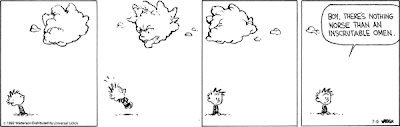
Most of us can see patterns pretty much anywhere. Among the stars, in the clouds, in stock market fluctuations…the list is endless. We also tend to see faces…on the moon, on Mars and in the clouds. As with pretty much everything else, why we tend to be such pattern seekers is answered by evolutionary theory. Dr. Sinha from MIT explains: “The information faces convey is so rich — not just regarding another person’s identity, but also their mental state, health and other factors. It’s extremely beneficial for the brain to become good at the task of face recognition and not to be very strict in its inclusion criteria. The cost of missing a face is higher than the cost of declaring a nonface to be a face.” Shinseungback Kimyonghun, a Seoul-based tech art collective, developed Cloud Face, a software designed to spot faces in whatever the camera recorded. They pointed it at clouds for fun and sure enough, the software spotted faces just like we humans do! About 1 face per 150 clou...

Smart Everything Isn’t Necessarily a Good Thing

All those smart devices seem to have taken the next step. Whether for good or bad is a matter of opinion though. With the falling price of sensors, almost every item can be fitted with one. Add a piece of software, often free, and you could be “seeing social engineering disguised as product engineering”. Huh? Take BinCam, a good old trash bin fitted with a smartphone on the top lid. When you drop stuff into the bin, it takes a pic, sends it to Mechanical Turk where freelancers check if your garbage proves whether or not you really care for the environment! And eventually, your photo appears on your Facebook page…to shame you. At least the BinCam is voluntary, you might say. And the idea is positive: to shame you into being better. Similar ideas include smart scales that tweet your weight online to add pressure on you to stick to that diet; smart medicine bottles that ping you and your doc if you aren’t taking that medication; smart forks that tell you are eating too fast and sma...