Posts

Showing posts with the label astronaut

Enlightened Astronaut, Part 3: Gravity Strikes Back
Image
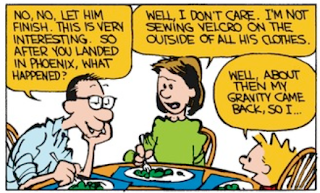
All that velcro-strapped stints on the treadmill can’t prevent the changes to an astronaut’s body, writes Chris Hadfield in “An Astronaut’s Guide…” : “Without gravity, we don’t need muscle or bone mass to support our own weight, which is what makes life in space so much fun but also inherently bad for the human body, long term.” Thus, when he returns to earth after months on the International Space Station: “My arms are so heavy I can barely lift them… It’s like being a newborn, the sudden overload of noise, color, smells and gravity, after months of quitely floating, encased in relative calm and isolation. No wonder babies cry in protest when they’re born.”   And the effect doesn’t go away… for months in his case (actually, its a one-to-one ratio between time in space and time to recover). Why? “After five months in space my body hasn’t just adapted to zero gravity, it has developed a whole new set of habits.” Walking is very painful: the legs find the weight of the body...
Enlightened Astronaut, Part 2: No Gravity

Image
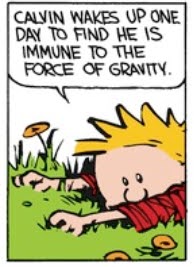
In “An Astronaut’s Guide to Life on Earth” , Chris Hadfield says that unlike earlier times, when space trips were short, now they often last several months: “As the stints in space have gotten longer and longer, your temperament matters. Are you easy to get along with?” And you don’t get to pick your team-mates. So yes: “Sometime integration is not so easy, because we don’t get to pick our fellow travellers. It’s like a shotgun wedding.” When that happens, focus on building the wall with the bricks you have: “At some point, you just have to accept the people in your crew, stop wishing you were flying with Neil Armstrong, and start figuring out how your crewmates’ strengths and weaknesses mesh with your own.”   Why those months long space trips? To conduct experiments, fix and install things, and “help make space exploration safer”. So yes, a lot of work: “A lot of time the work isn’t glamarous, but that’s okay. The workplace itself is , after all, in a pretty great ...

Enlightened Astronaut, Part 1: No Guarantees

The title of the book intrigued me: “An Astronaut’s Guide to Life on Earth” . Apparently, it isn’t enough to be the guy who gets to “experience yee-haw personal thrills in space”; Chris Hadfield is also wise. And a great writer.   Hadfield points out the “ yee-haw personal thrills in space” can happen only if you go to space . And no, not all astronauts go to space: “Getting to space depends on many variables and circumstances that are entirely beyond an individual astronaut’s control, so it it always makes sense to me to view space flight as a bonus, not an entitlement.” Sure, you’re super fit and able to withstand all those G-forces, but a Challenger or Columbia- like disaster can put all programs on hold. Or the only vehicle that can dock with the ISS (International Space Station) is a Russian one whose restrictions on height that you, sadly, don’t meet.   Therefore, do any training without expectation of reward, he advises: “You can’t view training solely as...

Astronaut Training

Image
In A Crack in Creation , her book on the gene editing tool, CRISPR, Jennifer Doudna mentions the time she found a tattered copy of James Watson’s The Double Helix on her bed: “My dad would occasionally pick up books for me at used bookstores to see if they sparked an interest.” My 6 year-old daughter likes to be read this book titled The Big Book of How . The first few points to the question, “HOW do astronauts train?”, were quite boring (for her). The next point was on training in zero gravity, so I decided to spice it up. It’s done by going on a plane that dives (like a free fall), I said. A falling plane? Now she was interested. So I drove home the advantage: Me : “You know the funny feeling in your tummy when you’re on a roller coaster?” She : “Yes” Me : “This is like that. But much worse. People even throw up.” She (all excited): “Really? They puke?” Me : “Yes. That’s why they call the plane the Vomit Comet.” Like all kids her age, she finds anything gross v...

Selfies

Image
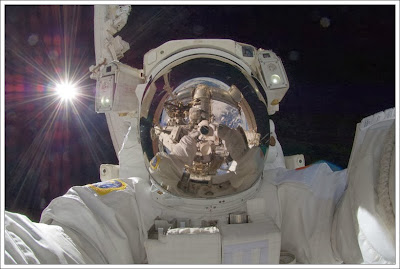
When Oxford dictionary recently announced that ‘selfie’ as their new Word of the Year (“photograph that one has taken of oneself, typically one taken with a smartphone or webcam and uploaded to a social media website”), I was reminded of Chris Gayomali’s article asking different people why they took selfies. Apparently, he wasn’t satisfied with the obvious answer: “The familiar if dull refrain is that selfies reflect the narcissism of our age, spurred by the easy sharing capabilities of smartphones and the cameras they house. Facebook, Instagram, and Tumblr provide potentially far-reaching platforms to broadcast close-ups of our faces, particularly the ones we deem fit for consumption by others.” Amy Rose Spiegel from BuzzFeed’s answer did have a point: “Selfies … are a way of taking ownership of my body and deciding how I want to be seen. Relatedly, we're all documented online so relentlessly as it is that why wouldn't you want to control the narrative of your own i...