Posts

Showing posts with the label inequality

Wealth Inequality

There was a recent paper that said that economic inequality in India has increased so much that it’s worse today than even during the British Raj – it’s the era of Billionaire Raj, it proclaims. Apparently the first version of this paper was published in 2017; and what we got now was the updated version.   Pranay Kotasthane isn’t convinced by the paper. He reminds us of a question that was asked about the first version – how does one find out the wealth of individuals? The original paper had used “survey data to estimate the incomes of the non-rich” and was “relying on income tax data to estimate the incomes of the rich”. Many had argued that the methodology was wrong on both fronts – (1) plenty of rich people don’t pay taxes (as we know all too well) and (2) who answers surveys honestly, let alone on a topic like how much wealth they have. Weirdly, the second edition of the paper doesn’t address these questions on its methodology, he points out.   Second, he says tha...
Is Inequality at the Point of No Return?

The only time we had equality, writes Yuval Noah Harari in 21 Lessons for the 21 st Century , was when we were hunter-gatherers. Why? “Because they had very little property. Property is a pre-requisite for long-term inequality.” Agriculture was the beginning of inequality. Increased industrialization accelerated things. But then, ironically, industrialization also contributed to the reduction in inequality. Admittedly, in a roundabout and twisted way. First, as the number of workers grew, they could form groups and unions and make demands. Next, when employee skills and intelligence began to matter, they were paid better and treated better. And as the demand for workers increased further, it opened employment doors for all “races, classes and genders”, eventually even other countries via outsourcing. All of which helped reduce inequality globally. After the fall of communism, it looked like greater prosperity and thus reduced inequality was going to be the global norm. ...

No Easy Solutions

Ever since the financial crisis of 2008 broke out, bankers became the hated lot who (nearly) brought the system down with their greed. But even more than their greed, the point that gets most people riled up is the fact that they had no skin in the game. When things were doing well, they got their commissions and bonuses; but when things went horribly wrong, the losses went to the suckers who bought their products (And don’t even get people started on the bailouts that followed). As Alan Shore said in Boston Legal , the common feeling is: “If Shakespeare were alive today he might say, “First thing. Let’s kill all the bankers.” The knee jerk reaction might be to go medieval with the rule book, a la Hammurabi’s Code: “If a builder builds a house for a man and does not make its construction firm, and the house which he has built collapses and causes the death of the owner of the house, that builder shall be put to death.” But that would be like turning the clock back a fe...

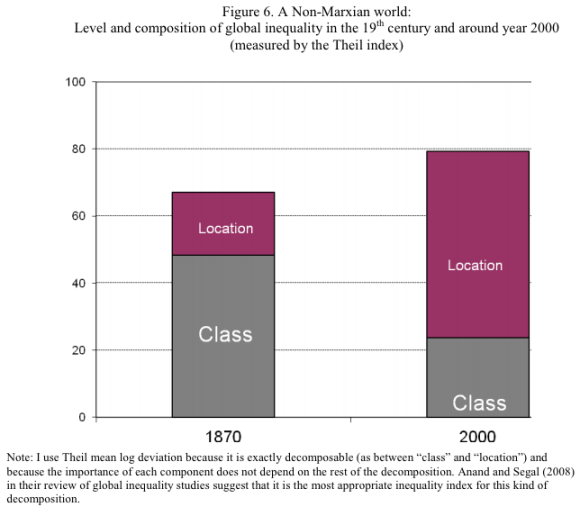
Location, Location, Location

Image
As transportation and communication technologies got better, faster and cheaper, where you were seemed to matter less and less. And with the Internet, many felt that geography (location) was history. Check out this chart on global inequality over the last century or so: Dylan Matthews explains the chart: “[C]lass rank matters far less than location in determining where someone falls in the global income distribution. That’s a big change from the 19th century, where class rank predominated. [Branko Milanovic, the lead economist at the World Bank’s research group] argues this means we live in a “non-Marxian world,” where the relevant cleavage is not between the proletariat and the owners of capital but between those with the misfortune to be born in poor countries and those with the great fortune not to be. “A proper analysis of global inequality today requires an empirical and mental shift from concerns with class to concerns with location,” he writes. “In other words, a m...