Posts

Showing posts with the label EU

Farmers Protest in EU

We are used to farmer protests in India. What are the reasons for the same across Europe, from France and Germany to Poland, wondered Pranay Kotasthane.   There are two immediate causes for it. First, the Ukraine war. When the war started, the EU removed the ban on agricultural imports from Ukraine. To help Ukraine. But that created a side-effect. Ukraine is so much more efficient and productive at agriculture than the EU that this move has hurt EU farmers. EU farmers are also worried that the ongoing trade negotiations with South America will further increase the import of cheaper agricultural products.   Second, the EU has changed several policies to reduce the effects of climate change. This includes measures like “reducing pesticide use, developing organic farming, protecting biodiversity, and sunsetting fossil fuel subsidies in agriculture”. All these moves hurt farming and farmers.   The specific cause for protests in different European countries are di...
Won't Learn, Won't Change - That's EU

David Wallace-Wells’ very long article points out that: “For decades, the richest nations of the world had told themselves a story in which wealth and medical superiority offered, if not total immunity from disease, then certainly a guarantee against pandemics, regarded as a premodern residue of the underdeveloped world. That arrogance has made the coronavirus not just a staggering but an ironic plague.” And as it has turned out: “It was these countries that suffered most, died most, flailed most.”   Even within those countries, the EU has handled it particularly badly. It started with a (Western) belief that the disease can’t be controlled, that China too would fail. Worse, the one measure that was used (and worked) across Asia – lockdowns – was dismissed contemptuously: “The shutdown was seen not as a demonstration of extreme seriousness but as a sign of the reflexive authoritarianism of the Chinese regime (and the imagined servility of its population).” They never...

COVID-19 Vaccines and the EU Fiasco

Image
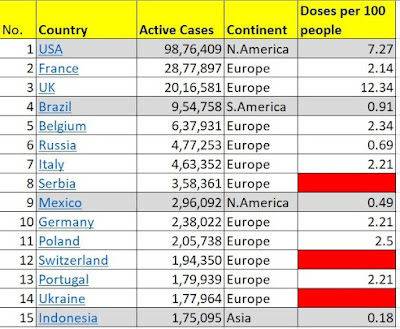
COVID-19 cases have spiked across the world in the last month or so, and here’s how the active count (i.e., people currently with the disease) of the top 15 countries reads: The worst hit continent is Europe (all the white rows); so I’ll be focussing on that.   Look at the last column which shows number of vaccine doses administered per 100 people . On that front, notice how far ahead the UK is compared is, and how some EU countries haven’t even started vaccinating (red cells). The EU negotiated its vaccine deals as a block, hoping to get better deals that way. On the price front, it succeeded. But at what cost, asks this article . The EU needed 27 countries to come to a consensus, which inevitably delayed decision making. The US and the UK struck deals at a faster pace; While the EU worked with international organizations like WHO, the US “blew that event off” and focused on securing itself first (Yes, the US has hardly handled COVID well, the point here is that they hand...

Is the EU Unravelling?

In Prisoners of Geography , Tim Marshall, says that post World War II, the “acceptance of the presence on European lands of a single overwhelming power, the USA” led to the birth of NATO and paved the way for the creation of the EU: “What is now the EU was setup so that France and Germany could hug each other so tightly that neither could get an arm free with which to punch the other.” The EU went on to expand to include more and more countries to become what it is today. It even created a common currency, the Euro: “They were all supposed to have levels of debt, unemployment and inflation within certain limits.” But the difference in wealth across nations meant an economic union was going to be a problem. Some like the Greeks were just “cooking the books”: “But because the euro is not just a currency – it is also an ideology – the members turned a blind eye.” Until the 2008 financial crisis, that is. Germans were up in arms when they found themselves having to bail ou...

EU and Unity in Diversity

The EU has 28 partner countries that speak “an unwieldy 23 languages” , as the Economist puts it. Some guy suggested that every Euro kid should learn two foreign languages. Others felt that everyone should just switch to English. Some of the arguments against English were interesting and informative, not jingoist: 1)       The language spoken by the maximum number of Europeans is, hold your breath, German! In 4 countries, German is an official language. 2)      French has just as many native speakers as English, and is official in 3 countries. 3)      And most embarrassing of all, Britain will soon be holding a referendum whether to quit the EU altogether! 4)      The EU’s official motto is “united in diversity”, a promise to not crush every member “under a homogenising wheel”. (Wait a minute, unity in diversity? Don’t we have a copyright on that slogan?) Now doesn’t all this make you...

Web of European Institutions

Image
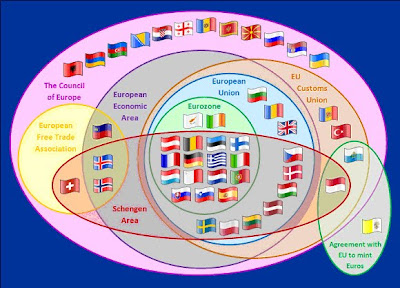
The first time most of us realize that there is difference among EU nations is when one comes to learn that the Schengen Visa isn’t valid across all those nations. Until I saw the pic below, I didn’t realize that the continent which claims European integration is its ultimate aim had so many different institutions related to that goal! Notice how many of them there are. And worse, how they overlap. Must be a bureaucrat’s dream come true! (On the bright side, here’s a very nice application of Venn diagrams). So what are all these groups? Eurozone : 17 countries that use the Euro as their currency. EU-but-not-Eurozone : Members of EU but don’t use Euro as the currency. Among these, only UK, Denmark and Sweden opted out of the Euro. The rest in that group (later day Eastern European additions) are obligated to eventually transition to the Euro currency. European Union Customs Union (EUCU) : No customs levied on goods moving within this group. Customs are only levied on goods entering the...