Posts

Showing posts with the label colors

Color me Dead

Once upon a time, humans “gathered colors from naturally occuring materials in the world around them”, writes Whitney Balick. Ochre dug from the earth, charcoal, minerals found locally, local plants, saffron, those were the sources.   All that changed in 1856 when William Perkin, a British chemist, stumbled upon a way to turn coal tar sludge into a colored dye: “Perkin’s discovery jump-started a revolution in synthetic dye-making that would change the way most of the world made color. It wasn’t long before other chemists began to figure out how to synthesize seemingly every color of the rainbow from coal tar and other petrochemical products.” This industrialization of color set off huge environmental damage.   Multicolored waste would find its way from industry into waterways and poison the local ecosystem. Humans nearby had reactions to the chemicals, from rashes to outright poisoning. The colored products could also wreak havoc, like the lead used in paints perm...
Colors

Image
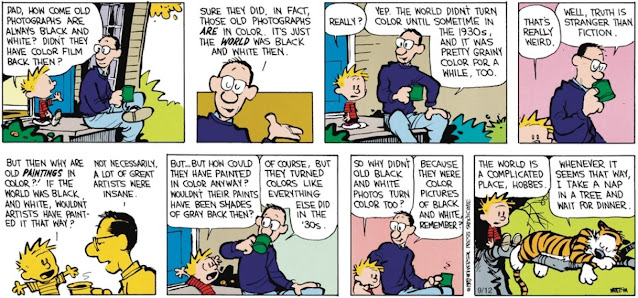
In Labyrinths of Reason , William Poundstone, described the “rotating color wheel” as a thought experiment: “Suppose that all the colors are changing… What is green now will be blue in a thousand years, purple in 2000 years, red in 3000 years and come full cycle back to green in 6000 years… (This rate of change is to tiny) that hardly anybody would notice.”   Bill Watterson used that idea to allow Calvin’s dad to have some fun: Lisa Barrett has a very different take on the topic of colors. In her book, How Emotions are Made , she asks, “Is an apple red?”. While the common sense is Yes (or No, it’s green or some other color), that’s the wrong answer: “The scientific answer, however, is no. “Red” is not a color contained in an object. It is an experience involving reflected light, a human eye, and a human brain.” But wait, unlike the case of sound, even the eye and the brain aren’t enough! “For the brain to convert a visual sensation into the experience of red, it must po...

What Color is it?

In his book, Labyrinths of Reason , at one point, William Poundstone asks if you’d be able to know if the way you see colors is the opposite of how others see it, i.e., would you be able to know if “the sensation you have been trained to call “red” is what everyone else calls “green””? You can’t compare with anything to prove either way because colors are described by comparing with something else! I was reminded of all that when I read Ed Yong’s article . Different animals can see different parts of the spectrum e.g. some snakes can see infrared light whereas mice can’t. Until Tian Xui and his colleagues in China came along: “(The team) injected the eyes of mice with nanoparticles that were designed to stick to the light-detecting cells in the rodents’ retinas. These particles convert incoming infrared light (that the cells cannot naturally detect) into plain old green light (that they very much can).” While this may be impressive (or horrific, depending on your point...

Color Me Blind

It is well known that girls can see far more shades of color than guys. Really. It’s not just that guys don’t care (we don’t); what we consider as shades of a color are often different colors to girls. I learn such things… by being insulted by my daughter. A couple of years ago, we went to this mall and decided to let my daughter pick a nail polish of her choosing. She pointed at one; and I told the sales girl to get us the yellow one. I was promptly and loudly corrected by the kid: “That’s golden, not yellow.” More recently, she asked me to name the color of the nail polish on her mom’s hand. Brown, I said. No, it’s maroon, she corrected. My wife then explained to her that guys can’t differentiate as many colors as girls. I often play matador-and-bull with my daughter (she’ll charge like a bull at whatever cloth I am waving). The other day, while watching some bulls on Discovery , I explained to her that bulls are color blind, and so it’s not the red cloth that trigger...

Seeing and Believing

Image
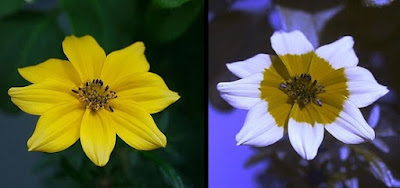
I remember how struck I was the first time I read these lines in Will Durant’s book, The Story of Philosophy : “All our knowledge of anything is merely our sensations of it, and the ideas derived from these sensations. A "thing" is merely a bundle of perceptions i.e., classified and interpreted sensations.” How different the same flower appears to a bee and us humans gets driven home by pics like these (Left = human vision; Right = bee vision): Ok, you say, but that’s two different species we are talking about. Then let’s take this pic which  different humans  see differently: Some see a young woman with flowing hair and a nice dress; others see an old woman with a wart on her large nose! Ashvin B. Chhabra makes an interesting observation about this pic in his book,  The Aspirational Investor : “What is interesting about this illusion is that our brains instantly decide what image we are looking at, based on our first glance. If your initial glance ...