Posts

Showing posts with the label Modi

An American Critique of Modi's Critics

Tyler Cowen, an American professor, make some interesting points about the criticism of Modi. Like many, he doesn’t favour “replacing India’s secular democracy with “Hindu nation” as a ruling principle”. First, he points out Indian democracy was never liberal: “National voting has so much to do with religion, caste, and other particularistic principles that Indian democracy never enforced superior practical performance as it should have.” Then a slew of factors lined up: Modi himself, India’s economic growth, higher expectations from the state, global terrorism and Islam being at the center of it. He says Modi’s critics focus on either his failures or the policies they dislike but ignore the positive actions he has also brought about: “The positive and negative sides of the story here may be more closely related than is comfortable to contemplate.” Cowen then draws a parallel to the Renaissance! “The picture reminds me a bit of how parts of Renaissance Europe wer...
The Sequel is an Even Bigger Hit

Image
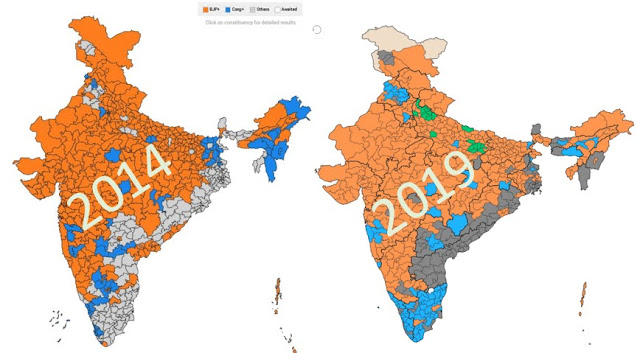
For once, the exit polls got the big picture right. Modi won, and the BJP got an absolute majority. There were surprises too. Like the BJP getting an even bigger absolute majority than last time. The BJP’s vote share rose from 31% last time to 41% this time despite a massive ganging up of all parties in pre-poll alliances. Rahul Gandhi lost in Amethi. Fortress Bengal was breached big time. See the maps below of who won where in 2014 and 2019. Whatever the BJP lost this time in Andhra/Telengana, it more than made up via the gains it made in the North East, West Bengal and Odisha. Mihir Swarup Sharma writes of the origin of the Congress’ “Idea of India”. At independence, especially after all the bloodshed of Partition, Nehru decided: “India is a bundle of contradictions, of competing group assertions, and it is the duty of the Indian state is to play an arbiter between them, to cover up and manage these centripetal and divisive forces through inclusion, representation and...

Demonetization and the Bigger Picture

I have held myself back from writing a blog on demonetization all this while feeling stating the short term problems it created was, well, just stating the obvious. On the other hand, the question of whether the move would yield long term benefits, well, couldn’t be evaluated until much later anyway. But the slew of left leaning/ what-has-it-done-to-the-poor articles forces me to write… I am not the least bit sympathetic with the middle class (or rich) folks who criticize demonetization by pointing out the problems it has created for the poor. It’s time we, the middle class, got selfish, and said that we’re going to evaluate demonetization and what it does for (to?) us: -          Does it create nightmarishly long waits to get small amounts of money? Obviously. -          Do people like us have alternate ways of paying for almost everything other than our maids, the newspaper guy and their likes? A...

Two Types of Change

The media is increasing unable to predict the outcome of an election: they didn’t see the BJP sweep of 2014, Brexit or now Donald Trump. But worse than that is the media’s unwillingness to take “r esponsibility for one's own unjustified arrogance and undeniable mistakes”, writes Damon Linker . Citing the Trump election, he points out how the media seems to confuse what they would like to happen with what they believe was going to happen: “Trump's campaign and personal behavior are so offensive to so many things that the members of these establishments take for granted, believe in, and valorize, that the thought that Trump could prevail electorally was close to unthinkable for most.” Substituting a desire for a prediction is an amateurish mistake. “None of the smart guys came close to grasping the truth — which is that they don't really know what the electorate thinks, and they don't know who is likely to vote.” Time after time we are seeing this phenom...

Narendra Modi and the Donald Trump Parallel

I have these ongoing debates with my dad on Narendra Modi. And that got me thinking of the parallels with Donald Trump. No matter what they did or said, they are extremely popular during election campaigns. And even win. But how can that be? How can such things happen in countries with a free press, with freedom of speech? How can it happen in a growing country and a rich country? Howard Kurtz points out how aggravating Trump is to his detractors: “They struggle to understand why he pays no penalty when they blow the whistle. What they don’t quite grasp is that their attacks only make him stronger. This is not to let him off the hook for mistakes, just to recognize that Trump has completely rewritten the rule book, infuriating those who thought they enforced the rules.” Those lines would apply equally to how many feel about Modi. But why doesn’t all this “blowing the whistle” work? Matt Taibbi talks of an increasingly common approach these days: “(A common approach is...

Parallels from Unlikely Sources

Many Indians look at Narendra Modi and say: sure, there’s enormous hype around the man, he gets rock star receptions every time he goes abroad, the corporate world loves him, he is a great orator and knows how to use social media extremely well, but where are the results ? That’s a fair question. Of course, the same question could be asked about the man known as the People’s Pope, the current Pope Francis. Extremely social media savvy, a man who talks frankly, sounds empathetic, and makes all the right noises about gays, abortion and the use of birth control. But as Gerald Posner wrote in God’s Bankers : “Francis’s words were carefully crafted. He never promised to make any substantive reforms or alter long-crafted doctrine.” Indeed, if you look carefully, no changes have been made to the church’s policies on any major (controversial) topic. So why are Modi and Pope Francis still so popular? Why does Modi get a rock star reception at Wembley Stadium right after the Bi...

Modi's First Year

The new channels analyzed to death the Modi government’s performance over the last year. Funnily, a couple of outcomes of the current government’s policies came to light only after that media phase had ended! Love him or hate him, Modi knows to switch his interfaces based on context. As the political campaigner, he takes shots at the likes of Mamata Banerjee. But as Prime Minister of India, he can work with her as CM of West Bengal! Publically. Like when he ratified the recent Land Boundary Agreement with Bangladesh at Dhaka with Mamata also present. The issue has been hanging since 1974! What’s in it for India? GVC Naidu wrote an excellent article explaining the benefits: 1)       The deal solves 4,000 km of land border problem. 2)      50,000 people thus move from a stateless situation to falling on one side. 3)      Indian cargo ships can now use Chittagong and Mongla ports in Bangladesh, which drastica...

Stop Whining about Modi

There are many like Gopalkrishna Gandhi who cry foul that the BJP managed to win an absolute majority of seats with just 31% of the vote. In the age of data and the Internet, you will surely find someone who crunches the numbers differently. Like R. Jagannathan . He reminds us that the BJP fought as part of an alliance, which means that it didn’t contest all 545 seats. In fact, it only contested 428 seats on its own. Raju Limbachiya says that the vote share of the BJP in those 428 seats it contested is 40%. Or if you see the vote share of the NDA, it comes to 38.2%. Jagannathan provides context for these numbers: “In multi-party systems in the west no party usually crosses a 40 percent vote share; as for the gold standard of mandates – a 50-percent-plus vote – it happens only in two-party races.” In any case, as Jay Mazoomdaar says : “It is one thing to oppose the politics of Modi-led BJP; quite another to question its decisive mandate…(as is being done by the) many o...