Posts

Showing posts with the label apps

Apps for Age Groups?

As someone who can appreciate good photography and art, I love Instagram (Yes, there’s a lot more to it than just pics of whatever people are eating). Every now and then, I’d show some really nice pics on the app to my 8 yo daughter. And since there is literally an endless stream of pics the app shows you, she’d then immerse herself of what is called “infinite scroll”, scrolling without end. Then one day, when I showed her yet another pic on the app, here is the conversation we had: She: “Isn’t this app for young people?” Me (wondering how she even knows such things): “Yes, what’s your point?” She: “Aren’t you too old for it then?”, adding pointedly, “Just as you say I’m too young for some things?” Me: “No, I’m not too old for it.” She: “Really? Aren’t you forty-whatever?” Forty-whatever? This from the same kid who gets mad when I can’t remember how old she is… FYI, kiddo, I don’t even remotely subscribe to the view expressed in this rant by an “adult”, Ni...

Tracking (Apps) for Kids

Image
A while back, we gave my 8 yo daughter my old smartphone so she wouldn’t keep taking our phones to play games. It didn’t have a SIM card, so it was really a computer + camera she had, not a phone that could make calls. And now she finds some kids in the apartment having smartphones with SIM cards, ergo the demand that she be given one too. So far we’ve stood firm but the question is when she will have one, not if . Since I’d started thinking about this topic, I decided to listen to this Short and Curly podcast on the next question that comes with giving a smartphone to your kid. Should you put tracking apps on your kid’s phone? Is it right and necessary? Or are you becoming like the KGB, Stasi and every surveillance state in history? It’s a tough choice: trying to balance privacy v/s safety. Kids feel they can take care of themselves, that they are not animals to be tracked continuously. But how do you as a parent know if the kid is mature to be out there without supervi...

Estimated Time of Travel

Usually I am not sympathetic to the complaints against the advertisement driven Internet model. Somebody’s got to pay for the service; so what if its via ads? To the common complaint that it incentivizes the site (Facebook, Google etc) to show you content based on the advertiser’s money, surely the site would lose its popularity over time if it kept thrusting content that you didn’t like/care about? But recently I saw a good example of a far more subtle behavior that ads can lead to in what sites show us. While there’s nothing harmful in what I will describe, it does show that the effects do exist. When people plan a trip, they use one of these apps to estimate time of travel: Google Maps, Waze or Apple Maps. The first two are ad driven, but Apple isn’t. Artur Grabowski compared the three apps. Here’s what he found: 1)       Waze’s routes are usually the fastest; Google is mid-way; Apple is the worst (relatively speaking). Nothing surprising so far...

Apps for Hamlet

Barry Schwartz gave a great TED talk on the “paradox of choice”: beyond a point, the number of choices is overwhelming to many. Many thought that the problem was the lack of information on the choices. But that wasn’t the issue. After all, isn’t Eugene Wei right when he writes: “The internet has intensified this curse, no one can make a purchase decision without reading a bunch of reviews online, or Googling “what is the best [X]” and trying to sift through a bunch of spammy websites to find some authoritative-sounding article. After all, the internet has democratized information and put it at our fingertips, isn't it our own fault if we don't own the best SLR or printer or kitchen blender, or if we don't go to the best ramen house in Tokyo on our one visit there?” Then again, if all you get is only “raw” information with no recommendations, it creates a new problem; what Dan Ariely calls the “burden of knowledge” : “If a doctor tells you that you have to make a dec...

Social Media Takes Over the News

Until recently, social media sites sometimes drove traffic to news sites (via links posted by their users). But now social media sites are displaying news content within their own apps. This changes the dynamics totally. Is news media becoming like wire services, wonders Ezra Klein : “Reporters will write their articles, and their content management system will smoothly hand them to Facebook, Snapchat, or Apple News…The publishers of tomorrow will become like the wire services of today, pushing their content across a large number of platforms they don’t control and didn’t design.” This transformation is just a reflection of the ground reality: “Twitter and Instagram and Vine and Snapchat and especially Facebook are larger concentrations of people than virtually any conceivable publication, and these people are clicking, tapping, scrolling and sharing more vigorously than people ever did on websites.” John Herrman points out that news companies that can “work out adve...

Filtering Photos

My wife doesn’t like the fact that I delete many of the pics on the phone very soon after I take them (I delete even more after I download them to a computer’s bigger screen). And it’s on this filtered content that I crop, zoom and apply the photo app and application filters. Why do I purge so many? Because let’s face it: most of the pics are average or worse, and certainly not the kind I would look back at years later fondly. I want to avoid what photojournalist Kenneth Jarecke describes: “Instead of having a body of work to look back on, you’ll have a sad little collection of noisy digital files that were disposable when you made them, instantly forgotten by your followers (after they gave you a thumbs up), and now totally worthless.” Most people, of course, don’t do that. They just post anything and everything they clicked and applied a filter on onto Facebook or Instagram. After all, isn’t What-I-had-for-breakfast the most common theme on Instagram? I agree with Ted Nym...

Communication Apps

Image
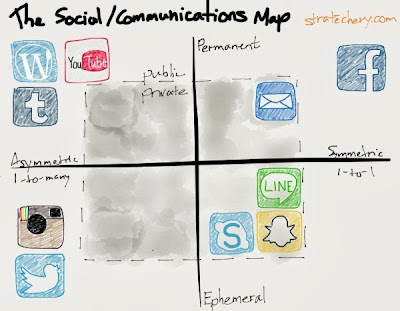
In one of his blogs, Ben Thompson listed 10 social apps he had used in the last two days (in no particular order): “ Twitter , for keeping up on news and commenting on tech and stratechery Facebook , for posting personal status updates and checking in LINE , for text messaging with my wife and friends in Taiwan Snapchat , for exchanging photos with my wife Skype , for instant messaging with my colleagues Facetime , for talking with my wife and kids Instagram , for posting cool photos Email , for all types of content, both work and personal Photostream , for sharing photos with my family WordPress , for posting to this blog” Why so many apps? Thompson’s answer: “Social is about communication, and communication is, and always has been, conducted through multiple mediums... There are three primary means of communication: text, photo, and video/voice.” He even drew a map of the different apps and the purpose they serve (1-to-1 or 1-to-many? Permanent or eph...

Apps for the Asocial and Bored

If you are tired of all those social networking apps that keep you up to date on every imaginable activity your friends have been doing, then you’ll enjoy the idea of these 2 apps: the first one is asocial, the second one mixes things up (literally). Apps like Foursquare keep track of where your friends are. Scott Garner devised this app called “Hell is Other People” that uses Foursquare data to tell you about places to avoid so that you don’t bump into your friends! The app is designed for days you want some peace and quiet; or for people who just want to be left alone. Garner says the app is “partially a satire” on social media. The second app is Instapuzzle. This one is aimed at people who get tired of staring at the endless stream of photos everyone seems to post via Instagram. How many filter applied photos can you see before you drift off, right? Instapuzzle allows you to select a photo and a difficulty level. It then splits the photo and scatters the pieces. You job i...

Kids and the Touchscreen Revolution

“The hands are the instruments of man’s intelligence.” -          Maria Montessori, developer of the Montessori educational system Maria Montessori was born in 1870 and died in 1952. Keep those dates in mind and re-read the quote at the top of the blog. Done? Ok. Now answer this: do you think Montessori would be turning in her grave to learn that developers who write baby and toddler apps for smartphones and iPads quote her lines to ennoble the touchscreen age?!  (I realized my 20 month young daughter expects everything to be touch enabled when she swiped PC monitors and expected a response!). So many apps on the iPad that my daughter plays with are interactive: fairy tales have options to dress the princess...with matching shoes and a tiara to boot (not that she understands any of it). She could paint the scenery (which she can’t, so my wife and I do it…happily) or do puzzles as she goes through the fairy tale. Welcome to the ...