Posts

Nero

Mention the Roman emperor, Nero, and the response will probably be “fiddling” (while Rome burnt). But of course, like all Roman history, Nero’s tale has so many other parts to it, as I found via this Hourly History book .   Nero, from age 4, was raised by his aunt. His father had died, and his mother, Agrippina, was exiled for treason against the emperor of the time, Caligula. When Caligula died, Agrippina was allowed to return to Rome. She set her eyes on the new emperor, Claudius, to secure her own as well as her son’s prospects…   Agrippina decided to marry the emperor even though she was his niece – but the Senate wouldn’t allow incestuous relations. Agrippina didn’t let that get in her way – she convinced Claudius to pass legislation to OK her marriage to him. Next, she got Nero to marry the emperor’s daughter from his previous marriage. And she browbeat the emperor to declare Nero, not his older son from the earlier marriage, as his successor. The stage was thus ...
Mongols: Men Conquer, Women Rule

If you come from a nomadic background, by definition, you don’t have much experience of building stuff. Or ruling anything bigger than a tribe. So when the Mongols stormed the world, how did Genghis Khan solve this problem?   Jack Weatherford’s The Secret History of the Mongol Queens gets into that part. Genghis divided up all the conquered lands and assigned rulers to them. Nothing special about that, except when you realize all the assigned rulers were women (his wives), not his sons or generals! His sons, he could see, were hardly promising material, while his generals were needed to expand the empire even further. But before that, Genghis needed to ensure peace in the already conquered areas. How did he do that? “Through a thick network of marriage alliances.” But he didn’t take on more wives. Instead, he made alliances for his children. The conquered tribe thus gained prestige and material benefits. Even more cleverly: “The husband (of his daughter) would go to war...

Entrepreneurial State and Apple

In her book on the Entrepreneurial State , Mariana Mazzucato says that even Apple, the company we associate with creativity (at least while Steve Jobs was in charge) didn’t really come up with new technologies. Rather, as Steve Jobs himself said about creativity: “Creativity is just connecting things… (Creative people) were able to connect experiences they’ve had and synthesize new things.”   Mazzucato says the iPhone is the perfect example of “just connecting things”, each of which was created by the State, not the private sector. These include semiconductor devices, ranging from the CPU to dynamic RAM (DRAM) to hard-disk drives (HDD). LCD’s (Liquid Crystal Display) too originated from government funded labs. So too did those tiny enough to fit in a phone Lithium-ion batteries. The entire field of DSP (Digital Signal Processing) was based on advancements to the Fast Fourier Transform (FFT). Then there’s the Internet itself which was created by the US military. HTTP and HTML ...

Yet Another Answer to that Famous Zen Question

In How Emotions are Made , Lisa Barrett asks the famous Zen question: “If a tree falls in the forest, and no one is around to hear it, does it make a sound?” As mentioned in an earlier blog , her book is about the “theory of constructed emotion”: “Emotions are not reactions to the world. You are not a passive receiver of sensory input but an active constructor of your emotions.” Barrett answers the Zen question in the context of the theory of constructed emotion: “A tree falling itself makes no sound. Its descent merely creates vibrations in the air and the ground.” It becomes a sound only if “something special is present to receive and translate them: say, a ear connected to a brain”.   Here’s the connection she draws to the constructed-emotion theory: “A sound, therefore, is not an event that is detected in the world. It is an experience constructed when the world interacts with a body that detects changes in air pressure, and a brain that can make those chang...

Yet Another "Use" of History

In both his books on the Mongol empire, Genghis Khan and the Making of the Modern World and its follow-up, The Secret History of the Mongol Queens , Jack Weatherford refers to something called The Secret History as a source. I always wondered why it is called “secret”. Sure, history is disputed, written by the winners, revised to suit whatever ideology is in vogue – we know all that. But “secret” history? That’s new…   Strangely, the Mongols didn’t seem to covet jewels and treasures as much as they did their documents and records! The Persian historian Rashid al-Din points out the Mongols went even further in how they maintained their records: “From age to age, they have kept their true history in Mongolian expression and script, unorganized and disarranged , chapter by chapter, scattered in treasures, hidden from the gaze of strangers and specialists, and no one was allowed access to learn of it.” Not only was it secret, it was deliberately chaotic in its organizatio...

Colors

Image
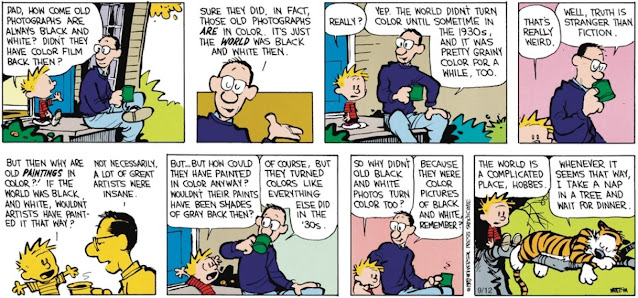
In Labyrinths of Reason , William Poundstone, described the “rotating color wheel” as a thought experiment: “Suppose that all the colors are changing… What is green now will be blue in a thousand years, purple in 2000 years, red in 3000 years and come full cycle back to green in 6000 years… (This rate of change is to tiny) that hardly anybody would notice.”   Bill Watterson used that idea to allow Calvin’s dad to have some fun: Lisa Barrett has a very different take on the topic of colors. In her book, How Emotions are Made , she asks, “Is an apple red?”. While the common sense is Yes (or No, it’s green or some other color), that’s the wrong answer: “The scientific answer, however, is no. “Red” is not a color contained in an object. It is an experience involving reflected light, a human eye, and a human brain.” But wait, unlike the case of sound, even the eye and the brain aren’t enough! “For the brain to convert a visual sensation into the experience of red, it must po...

Entrepreneurial State: Not an Oxymoron

The Entrepreneurial State. That’s the seemingly contradictory title of Mariana Mazzucato’s book . Yes, it’s about the government as an entrepreneur! The opposite of the bureaucratic, bumbling institution that we think of it is as…   A clarification first. Here’s what she is and is not saying: “The important thing for Government is not to do things which individuals are doing already, and to them a little better or a little worse, but to do those things which at present are not done at all.” Rather, she is talking of the State creating new technologies from scratch, by making high risk investments as well as using other tools at its disposal: “Whether the State is making an investment in the Internet or clean energy… it can do so on a scale and with tools not available to businesses (i.e., taxation, regulation).”   Why can’t/won’t the private sector do that instead? Because: “Real innovation can take decades.” And the private sector is way too impatient, wa...