Posts

Slime Lover

Image
Kids love slime. As if the bodily version wasn’t enough, there are toys with names like “Barrels O Slime”. The slime in each barrel comes in a different color. Yuck, you say? One’s man revolted reaction is another man’s marketing opportunity. So we have Yucky Science kits (yes, there is such a category) like Galaxy Glitter Crunchy Slime Making Kit . I guess different colors weren’t enough, the world was missing slime that could glitter. And be crunchy. You’d think my daughter would have been thrilled to get a kit like this. But no. Turns out her friend had already tried out a YouTube video to make slime. And failed. It won’t work, proclaimed the other kid with the pleasure that comes from dashing someone’s hopes. As far as a kid is concerned, in a parents v/s friends opinion contest, the friend knows best. Not one to accept defeat, my wife pretty much forced my daughter into trying the kit out. And boy, did it work. I am guessing the ingredients were perfect because she mixe...
Revolutionary Theories

Scientists are usually poor at people skills and at communicating things. The way they see it, the data and equations should speak for themselves. But that very skill becomes critical when a scientist comes up with a theory that is revolutionary and threatens to up-end the existing system. Take Max Planck, the man who founded quantum mechanics. It was easy for Planck to go ahead with his theory though it was revolutionary not because Planck was a great communicator but because he himself was reluctant to accept the implications of his own theory! Which is why Planck is always called the “reluctant revolutionary”. Not so was Ludwig Boltzmann. In an age when physics had been repeatedly proven to be deterministic and predictable since the time of Newton, Boltzmann said certain aspects were merely probabilistic. He insisted he was right and argued vehemently about it, but few at the time agreed and it caused Boltzmann no end of anguish and frustration. (He was eventually proven ...

Thought Experiments

Einstein made thought experiments famous. But he wasn’t the man who invented the concept. So what is a thought experiment? Based on certain assumption(s), you go over the logical consequences it would lead to. As Shane Parrish wrote : “The purpose is to encourage speculation, logical thinking and to change paradigms. Thought experiments push us outside our comfort zone by forcing us to confront questions we cannot answer with ease.” So who came up with the first recorded instance of a thought experiment? Not surprisingly, it was the Greek Zeno back in 430 BC. He used it to “prove” that motion is an illusion. Huh? His logic was this: assume the tortoise is 100 m ahead of the hare. When the hare covers the 100 m gap, the tortoise would have moved a bit ahead. When the tortoise covers that second gap, the tortoise would have moved a little bit ahead. And so on it goes. How then could the hare ever catch up with the tortoise, asked Zeno. What was the flaw in his reasoning? Galil...

Untangling the Web isn't Easy

CRISPR, the gene editing tool, allows for the editing of specific genes. The keyword is “specific”. To understand the point, think of breeding racehorses. While one gets to pick the “best” horses to breed, one has no control over which genes the child will inherit. That part’s still a roll of the genetic dice. But with CRISPR, one can target and edit specific genes. The level of control is unprecedented. And scary. Will it lead to the assembly line production of humans “superior” on whatever parameter we choose? Can we anticipate long term consequences of any such changes? Or would it be too late by the time we discover side-effects? Only time will tell how we decide to self-regulate ourselves with such powers. And how successfully those rules are enforced. The one area where it might seem that the benefits would outweigh the risks is when it comes to fixing genetic diseases. But that raises an existential question for pharma and biotech companies, what Goldman Sachs asks i...

Mathematicians and Apples

Image
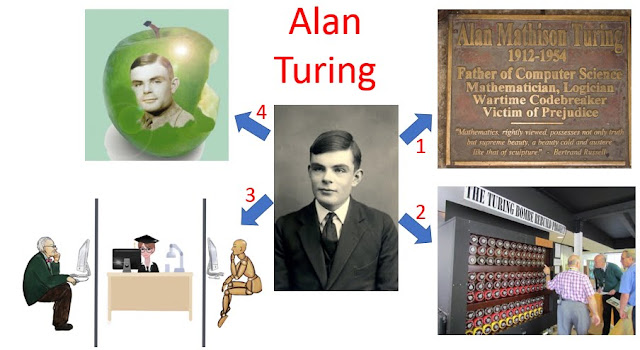
As part of the way to make kids comfortable with speaking in front of an audience, my daughter’s school has these periodic sessions where every kid has to speak for about a minute to the entire class holding a placard on the topic. Recently, the topic was any mathematician of their choice. Huh? -          How does a kid in 2 nd standard know about any mathematician (or “mathematic” as my daughter calls it)?! The only mathematician I know who did anything that a kid could understand was Gauss… as a kid, he found a smart way to add all the numbers from 1 to 100, an assignment his teacher had given. -          And what can one draw on a placard about a mathematician? Equations? Given the placard problem, I picked Alan Turing as the guy she could talk about. Come to think of it, all the points she used for her talk were about his work around computing, not maths! 1)     ...

Why so Serious?

Check out old photos of most Indians, and you’ll see that they didn’t know how to smile for the camera. They either didn’t smile at all, or they had a very tortured expression attempting to smile. Things have changed only after social media and selfies took over everyone’s lives. But even before social media, the expression of Indians in photos stood in sharp contrast to that of Americans. Seth Stephens-Davidowitz makes an interesting observation in his best-seller, Everybody Lies : “(Americans) went from nearly stone-faced at the start of twentieth century to beaming by the end. So why the change? Did Americans get happier?” Nope, wrong answer. The correct answer is far more interesting. Even better, it starts by answering a question most of us didn’t even think about! The first part answers why they had such serious looks to begin with: “When photographs were first invented, people thought of them like paintings. There was nothing else to compare them to. Thus, subject...

"How Much More Time?"

Kids in a car will drive you up a wall by asking the question, “Are we there yet?”. Every 2 minutes. And that’s if you are lucky; more often, they’ll ask the same question again within a minute. Is that because they’re so damned impatient and so easily bored? Or is it just not possible for kids to visualize distances or the passage of time? The point hit me when my daughter was watching this cartoon about 2 naughty school kids, Badrinath aur Buddhadev . The class was told that there’d be a 5 km marathon, upon which one kid promptly responded: “Just 5 km? What’s there in that? I can run that much in just 5 minutes.” Most adults immediately know that’s impossible. But if you step back to see how adults know that, it’s not because we can visualize the distance of 5 km or the amount of time 5 minutes implies. Rather, our brain uses the proxy called “speed” to assess the claim: 5 km in 5 min means a km per minute, which is 60 kmph. Cars go at that speed, not humans, therefore th...