Posts

Her First Exams

Until this year, my 8 yo daughter used to have monthly tests (and no exams). You’d think she’d have been happy with that state of affairs, but no. “Kids with exams get study holidays”, she’d whine, “I don’t”. This year she got her wish: exams and study holidays. Little did she realize it also meant a lot of studying. A lot. Be careful what you wish for, kiddo, it might come true. And boy, has it been brutal. For her and me both. The school had helpfully put out sample exam papers, and like any true blood Indian parent, I too had forced her to take it. Then there was the increased content to learn, far more than what she was used to in her monthly cycles. And last, but not least, she learnt to her dismay that study holidays are for, er, studying. As you can imagine, my daughter was soon sick of “so much studying”. On weekdays, on weekends, on study holidays . And since I was the one tormenting her, we had many exchanges during that period: -      ...
Regulating Social Media

Recently, the Supreme Court expressed its concern wrt social media and called for guidelines to curb its misuse. While it’s easy to understand the concern, unfortunately there’s probably no solution to the problem. It’s not just about India. Democracies world over make the same noises about social media, but pretty much every time one of them has framed laws on the topic, they’ve solved very little and end up creating a host of new problems. The cure turns out to be the worse than the disease. But why should that be the case? Just because nobody’s framed the right laws doesn’t mean it can’t be done, right? Hmmm… check out Ben Thompson’s podcast on the topic. He starts with the backdrop to social media. Historically, most markets check bad behavior via price. But with the Internet, it’s all free, the tool called “price” became inapplicable as a check. Unlike older mediums, the Internet allows anyone to find like-minded people somewhere or the other. So even if the pe...

Why we Deceive Ourselves

In their book, The Elephant in the Brain , the authors describe this weird aspect of deception that we practice: deceiving ourselves! That is so weird: “If our minds contain maps of our worlds, what good comes from having an inaccurate version of these maps?” The Sigmund Freud school of thought treats self-deception as a defense mechanism, “a way for the ego to protect itself”. The mind seeks to protect itself from anxiety and other negative emotions. Many object to this reasoning: since accurate information is so critical to our survival, surely distorting information would be dangerous. Wouldn’t the goal of protecting our self-esteem have been better achieved by making the brain’s self-esteem mechanism stronger instead? The new school of thought explains self-deception as “primarily outward-facing, manipulative, and ultimately self-serving”. This is based on Thomas Schelling’s work on game theory: “In a variety of scenarios, limiting or sabotaging yourself is the winn...

Money and the Kid

I wrote earlier about the difficulty of trying to teach one’s kid the value of money. And it just keeps getting worse: these days, even kids in the 7-9 age bracket compare how much money their parents have! After one such discussion, my 8 yo came to me, and without any hope whatsoever, asked, “Do we have at least 1 crore rupees?”. Apparently, that’s the minimum amount to be part of the kids’ club downstairs. If she’s ejected from her group, then she’ll be at home in the evenings. And if she’s at home, she’ll chew our brains out. So, I reasoned, the smart course of action was to say, “Yes, we have a crore”. Pariah status averted. A few months later, she noticed a car with a moon roof and asked if we could buy one too. “No, we don’t have the money”, I replied. “Why”, she countered, “I thought you said we have a crore”. That she can remember, but try to get her to study… More recently, she came home one evening all riled up. Turns out they were all setting up stalls down...

Programming, Half a Century Back

In his book titled Hackers , Stephen Levy describes how computer programs were written as recently as 1959: -        Not anyone could submit a program; you needed “official clearance” first. After all, the large-as-a-room computers cost a bomb; -        An operator would punch holes in long cards corresponding to the program: each hole represented an instruction to the computer; -        A “stack of these cards made a computer program”; -        Wait, there’s more! Those cards would be taken to another operator, who would feed the cards to a “reader” that would note where the holes were and dispatch them to the computer; -        As if all this wasn’t bad enough, it could hours, even days, before one got to see the output. And often it would just prove there was an error in the program! At MIT, the operators of the compute...

Removing Friction

A new company used to face several major challenges, far beyond the quality and/or price of its product: 1)       Distribution : Finding a way to make its product available far and wide. 2)      Marketing : Making consumers aware of their product. 3)      Visibility : In a shop, prime positioning had to be paid for to ensure your product was placed where it would be found/noticed easily. All of these points made it hard for new players to enter the market. They are also collectively called “friction”. Conversely, as Ben Thompson wrote : “Initial success was hard, but once achieved, a sustainable business almost certainly resulted.” But now with the Internet, “friction is gone”. Just think of the kinds of things you can find effortlessly thanks to Amazon. And then there’s bureaucratic friction, what Cass Sunstein called “sludge” in his recent paper : “Consumers, employees, students, and others are often...

The Standard Model... and Beyond

Image
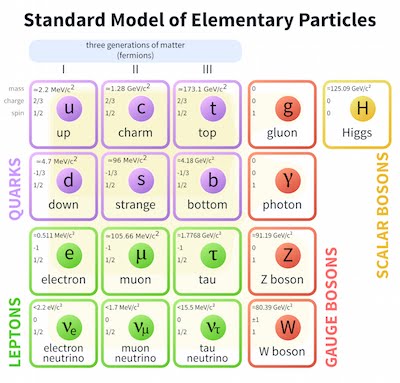
Elias Riedel GÃ¥rding wrote this short and sweet article describing the particles that make up the Standard Model of physics. At school, most of us thought that list consisted of electrons, protons and neutrons: “But atoms are not the end of the story… Protons and neutrons are themselves composed of tiny constituents called  up-quarks  and  down-quarks  (a proton consists of two up-quarks and one down-quark, a neutron of one up-quark and two down-quarks).” Ok, is there anything in the universe not made of electrons and quarks? There’s one answer that is familiar to most people: light. And it is made of photons. With photons, are we done with the list of all particles then? Nope: “We have discovered a whole slew of them (other particles) in cosmic rays and in particle colliders.” Here is where things stand today: “After much head-scratching, it has turned out that they are all different combinations composed from a small set of particles that are – as f...