Posts

Showing posts with the label states

Contested Indian History #4: State Controversies

Education was a state subject at independence. The first controversy based on a state history textbook was in 1957 when the CPI formed the government in Kerala. Via the Election Bill, Kerala restricted the hitherto unlimited powers enjoyed by private management in the field of education, and conversely, gave the state government far greater power in setting textbooks, writes Shaan Kashyap in Who Owns History?   Large pictures of Karl Marx, Lenin and Mao adorned Class 8 textbooks.   The Russian Revolution was glorified. China, the books said, would race ahead of India because they were communist. The achievements of non-communist countries were ignored. Not surprisingly, a huge uproar followed, both within Kerala and from sections of the Center. Accusations of “communist history” and “ideological indoctrination” to brainwash the next generation flew around. “They have a found in the nationalization of textbooks a fertile ground for indoctrination.”   The Directo...

Sad State of SFC's

The Union Finance Commission is the entity that recommends how to split the tax pool between states and the center. Less well known are the State Finance Commissions (SFC) that were constituted in 1992 to decide on the next level – how to split the tax pool between the state and local governments.   Few states have bothered to reconstitute SFC’s every 5 years, as called for in the 73 rd and 74 th amendments to the constitution. Further, the recommendations of the SFC are delayed, on average, by 16 months. Worse, SFC members are usually serving politicians and bureaucrats, which means bias is almost certain. If SFC’s recommend increasing the money given to local governments, then the recommendations are always rejected by (who else) the state government.   The problem, as Pranay Kotasthane says starts with those constitutional amendments: “These amendments left the devolution of funds and functions to local governments at the discretion of the state government. And...

India's Population Growth Rate

Image
Is India’s population still growing? Or does the answer vary drastically across its states? This blog is not about the political (and therefore emotional) connection of those questions to the topic of delimitation. Instead, it is about the at-times surprising answers to the questions, without the political and moralising aspects .   Rukmini S’s post presents the data on this superbly. Even without China or Sanjay Gandhi-like birth control measures, the following has happened. “There was certainly a time when India's population was growing very fast. In the three decades after Independence, India's population had doubled. But from the 1980s, population growth began to slow down.” Today, India’s population growth rate is below the global average !   Unintuitively, all states are slowing , though they slow at different rates : “Until the 1970s, population growth rates in different states were quite similar. However, since the 1980s, India's southern states have...

Does India Need More States?

Image
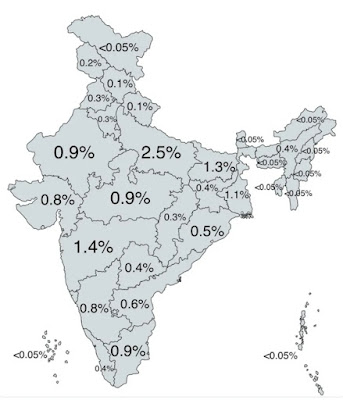
Some guy tweeted a pic that captured the fraction of the world’s population ( not India’s population, but the entire world’s) living in each state of India: While most of us wouldn’t have known the actual percentages the way the map shows it, overall, it is hardly surprising to most Indians.   Pranay Kotasthane drew an interesting inference from the map. Taking UP as the example, he points out: “There’s no way an Indian state government with current levels of capacity can provide for 2.5% of humanity. ” He added another very relevant comparison: “UP, for example, is twice as populous as China's most populous province, Guangdong.” Therefore, he says: “We probably need twice the number of states as we currently do. ”   He then takes an interesting digression into the basis on which the states were created at independence. Yes, on linguistic basis. On that: “(BR Ambedkar ) made the critical distinction between “one language, one state” and “one state, one ...

Story of India's States

The “inner (state) lines” of India, as Salil Misra describes in his wonderful article , were drawn in the past “not according to geographical factors, but the discretion of the ruler, the pattern of conquest, and the convenience of revenue collection”. He was talking of the Mughals and the British. In the 1920’s, the Congress decided to make “language the major determinant in the creation of administrative units within India”. As opposed to British units like the Madras Presidency that had “a large number of Telugu, Oriya, Malayalam and Kannada speakers”, for example. But Partition changed all that. Nehru, Patel, Gandhi, Ambedkar and others realized that the concept of a united nation needed to be “protected against certain political tendencies from within”: “It was felt that a strong linguistic passion, bordering on chauvinism, could be one such tendency. It began to be argued that strong linguistic passions might come in the way of national considerations.” And so the n...