Posts

Showing posts with the label learning

The Credit Assignment Problem

Image
Conditional reflexes. It is what an animal learns by repeated exposure. If a bell rings, then food is served, the dog will (over time) start salivating when the bell rings. Even before the food is served. What is strange is that such conditional learning does not need a brain. It even happens in creatures without brains. Brain or no brain, such learning is called acquired learning .   Say, you now start ringing the bell but don’t serve the food afterwards. For just a few days. As expected, over time, the animal will stop salivating when the bell rings. The association has been removed, a process called extinction . After those few days, you re-establish the bell-food sequence. The animal will start salivating again, a process called spontaneous recovery . Turns out the association was supressed , not deleted .   Next, you break the bell-food for a long time. Then after that long period, you restart the bell-food sequence. The animal will start salivating again. The s...
Mistakes and Intelligence

At a time when computers were still as large as rooms, worked on vacuum tubes that would notoriously conk out all the time, when the concept of software programs was still in its infancy (you had to re-wire the machine physically for every new activity), Alan Turing was already thinking way ahead. Could machines become intelligent, he wondered, in 1947.   He pointed out that humans, in logical fields like maths, make mistakes. But with machines, we have zero tolerance for errors. If we continued with that approach, then machines can never become intelligent, he said in a lecture: “If a machine is expected to be infallible, it cannot also be intelligent.”   Another mathematical genius, John von Neumann, shared Turing’s view. By 1952, the idea of software (instructions given to a computer to do different things, without needing to re-wire the machine) was not all that uncommon. With humans, he said, we accept that making mistakes (and learning from them) is how we gain...

Learning, Unlearning, and Seeking out the Best

We are told that winning isn’t everything. That it matters more whether we learnt something even when we lost. That’s true. But there’s the danger of taking that approach too far, like the time the Scottish Grand Master, Jonathan Rowson Rowson lost a game of chess. He narrates what followed in his book, The Moves that Matter . When asked what just happened, he replied (in what he thought was a clever response), “I learned”. Upon which his well-wisher snapped back: “You know this has to stop. This is not a university now.”   Rowson took a while to understand the point being made: “Deep learning requires us to play the game “as if” the result really mattered. Without that commitment, we risk remaining in a self-fulfilling narrative of being a learner.”   The other side of the coin to learning is “unlearning”. The latter becomes the only way to make progress once you plateau at a certain level at anything: “You realize that most of your mistakes are based on things ...

How we Learn Best is so Unintuitive

Imagine a teacher who asks a maths question to the class, then gently nudges the students towards the correct answer (affirmation when they are on the right track; correcting them when they seem to be going off the path). A variant of the above approach is what David Epstein describes in Range : “’Lemme show you, there’s a better, easier way.” If the teacher didn’t already turn the work into using procedures practice, well-meaning parents will.”   Next imagine a second teacher who lets the students try and solve it on their own. No feedback in real time. Afterwards, she corrects the paper and includes notes on the right approach (if needed).   Which way do you think results in better learning? Not just for the duration of the class or course, but in the long run? It’s the let-them-struggle, let-them-fail approach that yields better learning, not just in that course/class, but in long term retention as well!   There’s even a term for it, the “hypercorrection ...

Inductive Learning

For a very long time, Artificial Intelligence (AI) seemed no match for the supposedly “easy” tasks. “Easy” as in the ones that even small children can do, like lifting blocks and stacking them to form a tower. Or identifying objects in a pic. The problem wasn’t just about processing power or good enough sensors, because those were getting better and cheaper all the time. So what then was the problem? But before I get to that question, remember “machine learning”? Over-simplified, it is the most popular way machines learn: 1)       Load just a very few, very high-level rules into the computer; 2)      Throw a whole lot of data at the computer to interpret on its own ; 3)      Let the computer create its own rules, include changing existing ones ; 4)      Repeat steps 2 and 3. Step #3 is why it is called “machine learning”. It is also the attempt at AI that has yielded the most results fr...

Learning from Calvin, the Phone, TV and...

Image
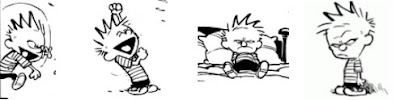
Appreciating Bill Watterson : My 7 yo has begun to appreciate the art in Calvin and Hobbes . Especially Calvin’s expressions, from that wicked look to pure bliss to grumpiness and anger: Making faces : The other day, when I stuck my tongue out at her (it feels so good to do that), she challenged me to a “Who can make the uglier face?” contest. It was a massacre: is it a kid thing or did she learn from Calvin? Upside of phone games : The (phone) game of the month in her circle is Granny , involving a haunted house and the proverbial witch. As I told her yet again to not spend so much time on that game, she turned around and told me, “Playing this game will help me overcome my fear of ghosts and the dark”. Nice try! I need a volunteer : It’s not just the phone. Kids can weaponize stuff learnt from the TV too. Seeing the Heimlich Maneuver, a technique to save someone who is choking, she was instantly attracted to the (necessary) violence of the move. Needing a victi...

Blood in the Wall

A couple of years back, I put a torch behind my daughter’s hand, turned it on, and voila! Her hand appeared red in color. I told her it was because blood is red in color. Because that’s what I’d been told as a kid. But that’s not the reason at all, as I learnt later. The correct reason is: “Only one color of light passes completely through your hand- and that's why it looks red. All of the other colors are completely absorbed, either by the skin, bones, muscles, blood or other cells in your body. Most of the red light passes right through all of these cells…” But wait, things are even more interesting: “Most of the red light passes right through all of these cells except your blood cells- but not even all of your blood cells. Red light passes through the blood in your arteries, but is absorbed by the blood in your veins. That's why your veins appear black.” (The difference between arteries and veins is the amount of oxygen in them, which affects how much of the ...

Learning from History

There’s that famous saying about those who never learn from history. But is it even possible to learn from history? Or is it an impossible goal altogether? Part of it has, of course, to do with ego. Who really thinks that they are embarking on a course of action that has already been attempted, and failed at, for the exact same reasons? Also known as the I-am-smarter-I-am-stronger feeling. Besides, just because the last guy got burnt at something doesn’t mean the next guy can’t succeed at it, right? Then there’s the difference between history and science. Or to put it differently, life isn’t a lab experiment, and no two situations are exactly the same. As Michael Mauboussin pointed out: “The challenge with history, however, is that it’s a very fickle teacher. Which is a lot of the key to understanding history is what the circumstances were.” Assessing the circumstances is a subjective choice; you can either willfully ignore things based on your view or often, not even be...