Posts

Showing posts with the label Evolution

Colour #2: Magnus and Evolution

In the last blog , we saw how Gladstone’s analysis seemed to suggest that the Homerian Greeks were colour blind. Lazarus Geiger came to a similar conclusion when he went over the Vedas – the ancient Indians seemed colour blind too, as were the Old Testament era folks. No word for blue, for example. The Icelandic sage and the Koran share some of these characteristics, writes Guy Deutscher in Through the Language Glass .   Therefore, concluded Geiger, all of mankind must have been colour blind (relative to us today) in that era (Ancient Egypt didn’t fit in: they used blue paint and even had a name for it. But they were considered the exception to the rule). But how does one check if this colour blindness theory was true? ~~   Enter Hugo Magnus, a Prussian ophthalmologist. His contribution was facilitated by events which made the topic of colour detection a practically important topic, not just a philosophical musing.   In 1875, two Swedish trains had a mass...

Evolution of Language #2: One Explanation

Image
In the previous blog in the series, we saw all the difficulties in explaining the evolution of language. Now to one possible explanation, from A Brief History of Intelligence by Max Bennett.   The book goes into a seemingly unrelated topic, altruism . In all species, one can see altruism towards kin (children, siblings etc). Many species also show reciprocal altruism (you scratch my back, I scratch yours). Humans go far, far beyond both. People help strangers without any expectation. They give to charity and do philanthropy. At the same time, as a species, we can be outrageously cruel . Only humans do genocide, wipe out entire groups.   Back to the topic of language: “It is not a coincidence that our language, our unparalleled altruism and our unmatched cruelty all emerged together in evolution: all three were, in fact, merely different features of the same evolutionary feedback loop.” He elaborates.   Language may have started off as intended only for ...

Evolution of Language #1: Wallace's Problem

In A Brief History of Intelligence , Max Bennett asks: “Is language an evolutionary invention or a cultural invention?” He investigates.   In the 1800’s, a scientist named Broca identified a region of the brain (called Broca’s area ) which was necessary to speak. People in whom that area was damaged could not speak anymore.   There was another kind of patient who could speak but the sentences made no sense whatsoever! Analysis identified damage to a part of the brain, and the condition was named Wernicke aphasia after the man who identified it.   Two different areas of the brain for understanding speech and for speaking . And they are wired together. Sounds like we found the reason why humans have speech, but not other species like apes. Unfortunately, that is not the case.   Turns out those 2 areas of the brain evolved in a common ancestor, i.e., even apes have Broca’s area and Wernicke area. So it was not the evolution of these 2 areas in the...

Human Errors #5: Sickle Cells and Goldilocks

We know that evolution eliminates harmful genes; and yet we find some of those disease-causing genes continue in the gene pool. The easy answer in some cases is that the disease in question occurs after the individual has already had babies, which means the genes were transmitted before they did the harm. In others, the answer is that it’s a combination of genes that causes the problem, so there’s no easy way to eliminate all the genes in question.   But that still leaves a few single gene-based diseases that act (and kill) young. Like the (in)famous Sickle Cell Disease (SCD), writes Nathan Lent in Human Errors . It results in “mutant versions of haemoglobin”, the molecule that carries oxygen in our blood. A fatal drawback, obviously, if your blood can’t get enough oxygen around. Surely such a gene should have been eliminated long back. “Yet this mutant coding that causes SCD is hundreds of thousands of years old, and it has appeared and spread – spread! – in many differen...

Reality

I found Donald Hoffman’s book, The Case Against Reality fascinating. It felt like a description of one aspect of Hindu philosophy explained via analogies I am familiar with. The aspect in question – do we perceive reality as it is?   The answer is No. He says our senses convey a picture of reality that can be compared to icons on the computer or smartphone: “The purpose of a desktop interface is not to show you the “truth” of the computer – where “truth”, in this metaphor, refers to circuits, voltages, and layers of software. Rather, the purpose of an interface is to hide the “truth” and to show simple graphics that help you perform useful tasks such as crafting emails and editing photos.”   Evolution, he says, has made us evolve in a way where we seek not truth, but whatever increases our odds of survival: “Perception is not a window of objective reality. It is an interface that hides objective reality behind a veil of helpful icons.” Helpful wrt survival, tha...

"Tree of Life" is Tangled: the Web

In the last blog , we saw how “endosymbiosis” complicated the idea of the tree of life. David Quammen’s book, The Tangled Tree , continues.   Why have bacteria gotten resistant to antibiotics? The usual culprits are indiscriminate over-use, and the evolution of bacteria themselves. But here’s a less known point. The genes that evolved in one bacterial species to confer resistance to the antibiotics seemed to become prevalent in almost all bacterial species. How could this be? Sure, it could happen by chance in one species, but how could the same exact solution popup in other species?   Wait, it gets weirder. Did you know that some of these antibiotics resistant genes existed even before the first antibiotics were discovered by humans? Huh? This sounds like a reversal of cause-and-effect! What was going on?   But before we answer those questions, let’s go to the 1920’s, when Fred Griffith stumbled onto something when testing two variants of a bacteria. Type ...

"Tree of Life" is Tangled: Fusion

When we think of evolution, most of us have the “tree of life” view. Life started. Mutations occurred. Most were harmful, but a few proffered some advantages, and became more widespread. Over time, the extent of change due to cumulative mutations was so large that they couldn’t mate, and that’s when we say a new species has arrived. Or to use the tree of life analogy: the trunk of the “tree” has split into two branches. And the process repeats itself. The branches fork further and so we eventually see so many species.   This is also the view Darwin himself had. But over time, science and technology is showing that the tree of life view isn’t entirely right. Since the “tree” view is so widespread and easy to understand, David Quammen calls his book on the topic as The Tangled Tree .   Evolution moves slowly. Or so we are taught. Yet, the difference between bacteria and pretty much all complex life forms is colossal. How did that happen? Lynn Margulis noticed a key diffe...

The Road to the Theory of Evolution

As it became evident that mass extinction events had happened in the past, Christianity scrambled to explain them. Yes, they were cataclysmic events, but they were “directional and purposeful” went the argument, writes David Quammen in his wonderful book The Tangled Tree .   In the 1800’s, a geologist, Charles Lyell, published a book that said the processes and events that shaped the earth were erosion, deposition, and volcanic eruptions. And he added that those forces also led to extinctions. Edward Hitchcock was aghast at this view of a planet that could “exclude a Deity from its… government”. Lyell was a believer in God, not an infidel, but the risk Hitchcock saw was that the theory might drive others into godless ideas…   He was right. Well, at least in the case of one particular reader. His name was Charles Darwin and he combined three points to form his famous theory:         Offspring resemble their parents - inheritance     ...

Oxygen's Impact on Evolution

Did a rise in oxygen levels in the atmosphere lead to the rise of complex life forms? The question doesn’t make sense at first. We know life adapts to whatever is available. By that token, oxygen levels can at most be the backdrop for however life evolved, but surely they cannot be called a causative factor…   In case of oxygen though, things are very different, writes Nick Lane in his book named (what else?) Oxygen : “The most obvious basis for a causal link is energy production.” Huh? “Oxygen releases more energy from food than do sulphur, nitrogen or oxygen compounds acting as oxidants… The length of any food chain is determined by the amount of energy lost from one level of the chain to the next.”   Without oxygen, that efficiency is less than 10%. Put differently, it means each step of the chain gets only 10% of the previous step. Here is the key point: “Below a 1% threshold, there is not enough energy available to eke out a living.” Do the maths, and ...

TV Over the Years

Image
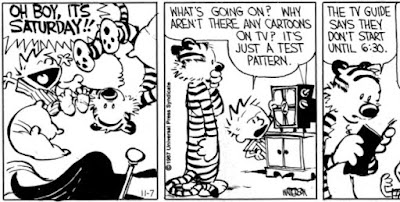
In her Reading & Comprehension passage, my 8 yo daughter was horrified to learn that there were no TV’s in India around 50 years back. And that we got to 2 TV channels only around 30 years back, and even then only in the metros first. She didn’t believe me when I added that TV broadcast were not 24 x 7, that they were only available in a certain time window: As someone born in the age of cable and who now lives on Internet based TV (Netflix etc) only ever since we cut off cable, these are alien concepts for her: Then again, the move to Internet TV means kids these days are not guilty of being like this in front of the TV, something our generation was very guilty of: Watching Internet TV is not “passive entertainment”; they actively search for what they like and watch it. As one comedy serial put it, the definition of Hell used to be that if you went to the bathroom, you missed it for good; if you missed an episode, it wouldn’t come again for years. Not ...

It’s All Relative

I remember this part in one of Richard Dawkins’ books where he tried to answer the question as to how gradual evolution can give any survival advantage. Citing the evolution of the eye, someone had asked him what good is a partial eye? Doesn’t it have to be a fully functioning eye or nothing at all? Why would evolution favour a partial eye? Dawkins went on to answer that by stating that a 2% eye is better than no eye (blindness), and a 4% eye is better than a 2% (even a slightly better chance of spotting the prey or predator can make all the difference when it comes to survival) and so on all the way to 100%. I just got another example from a totally different domain recently. My 6 month old baby can roll over and swivel a bit. I was getting impatient and wondering when she would make some progress beyond that. I got my answer when my wife visited a friend with a baby that was a month younger than ours. That baby (being younger) could not yet roll over. So our heroine, when placed ne...