Posts

Showing posts with the label Apple

Mathematicians and Apples
Image
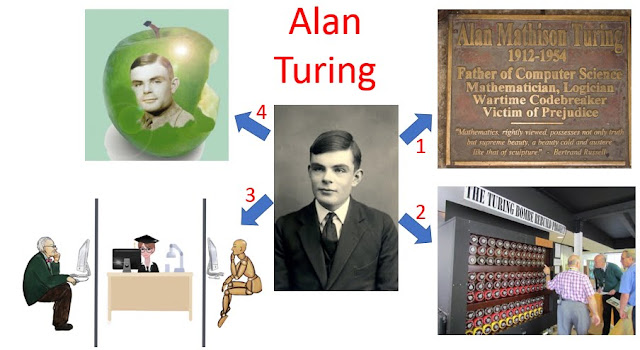
As part of the way to make kids comfortable with speaking in front of an audience, my daughter’s school has these periodic sessions where every kid has to speak for about a minute to the entire class holding a placard on the topic. Recently, the topic was any mathematician of their choice. Huh? -          How does a kid in 2 nd standard know about any mathematician (or “mathematic” as my daughter calls it)?! The only mathematician I know who did anything that a kid could understand was Gauss… as a kid, he found a smart way to add all the numbers from 1 to 100, an assignment his teacher had given. -          And what can one draw on a placard about a mathematician? Equations? Given the placard problem, I picked Alan Turing as the guy she could talk about. Come to think of it, all the points she used for her talk were about his work around computing, not maths! 1)     ...

Privacy or Improved Service

Apple and Google. As Paul Nickinson wrote in his blog : “Apple makes a kick-ass product. Google makes killer services.” Combine the two and you get a “phenomenal Google experience on the iPhone”, as Rene Ritchie put it . And yet Apple keeps sniping at Google, especially on the data privacy front. Like the time when Apple’s CEO, Tim Cook wrote in a public letter : “We sell great products. We don’t build a profile based on your email content or web browsing habits to sell to advertisers…We don’t read your email or your messages to get information to market to you.” To which Ben Thompson says sarcastically : “You can almost hear it now: How admirable! Golly gee, Apple is such a better company than those hypocritical evil-doers at Google! Why can’t everyone treat customers so well? Apple good. Google bad. Facebook worse.” Thompson then goes on to point out: “User information of this type isn’t important to Apple’s business model, so they “choose not to retain it.” The...

Imitation, Flattery, Patents and Copyright

“Imitation is the sincerest form of flattery.” For the upcoming Jurassic Park movie, they invented a new dinosaur! Most of us would probably feel the way Nilay Patel felt about that : “The whole point of Jurassic Park is to bring real dinosaurs into the present day...Take away the real dinosaurs, and you're just left with a made-up monster movie.” So why then did they invent a new dino? Tim Carmody responded to Patel on Twitter on the possible reason: “We need clear IP on the dinosaur, the toy companies say they can’t have any copycats this time.” Wait a minute…You can get IP (intellectual property/patents/copyright etc) on a species that roamed the earth? Is that insane or what? Of course, IP is not always a bad thing. If it weren’t there, what would be the incentive for anyone to come up with new ideas, like lifesaving pharmaceuticals? Then again, IP does cover areas between pharma and, I don’t know, dinosaurs. Like industrial design. Apple’s head of desig...

Apple Createth and Apple Destroyeth

Private companies that become very large, influential, corrupt and “evil” are not all that uncommon. In the pre-Internet age, to become bigger beyond a point required government support (legally or illegally). Even in capitalistic nations. Just consider the coal scam and 2G scam to see the role of government in enabling private companies on their way to dominance. Or take the East India Company that even got military backing from the British government: it was so big that it accounted for “half of the world's trade” as per Wikipedia! But the Internet era companies, while equally big (and potentially evil), don't rely on government backing to become what they are, especially in capitalistic countries (did the government force you to join Facebook? To search using Google? To buy via Amazon? Conversely, did the government do anything to prevent others from competing with these companies?). And then there’s Apple. Apple had accumulated a cash hoard of $150 billion jus...

Ads, Privacy and All That Righteousness

Image
The company so many love to hate, Facebook, recently announced that it would ignore the Do-not-track setting on your browser . It’s easy to see why Facebook would do something that could potentially invite a lot of ire: More tracking -> more knowledge about you -> more relevant ads -> more money from advertisers. Facebook justified the move by pointing out that “currently there is no industry consensus” on this topic (Twitter and Pinterest honor the setting; while Google and Yahoo do not). To which John Gruber retorted : ““Google does it” is not exactly a badge of honor, privacy-wise.” It sounded strange to me when Facebook simultaneously said that it will honor the settings to limit ad tracking on iOS and Android devices. Until Gruber pointed out that Facebook is just making a virtue out of necessity: “On iOS, they have no choice. Apple’s privacy controls are in the hands of the user, not the developer or advertiser. That’s why the whole “Do Not Track” thing for...

Dogfight for Mobile

I read this adapted extract from Fred Vogelstein’s book, Dogfight: How Apple and Google Went to War and Started a Revolution , and boy, I am already drooling to read the book. In 2005, Google was already working on its smartphone project. But two years later, when Steve Jobs launched the iPhone, Google felt like the “iPhone was a kick in the stomach”. Here’s how one of the architects of Android (Google’s smartphone OS), Chris DeSalvo, described his reaction to the iPhone: “As a Google engineer, I thought ‘We’re going to have to start over.’…What we had suddenly looked just so . . . nineties.” Google’s plans for the smartphone market were based on three points: 1)       Eventually, technology and bandwidth would allow people to surf on the move, via their phones. 2)      Telecom carriers would have to come around to the phone-as-more-than-something-to-make-calls-with view (feels like such an ancient view today, doesn’t it?). ...

God, the Devil and Elephants

There’s that famous observation that if someone tells you to not think about an elephant, then that’s the exact thing that will leap to your mind. Pretty much all of us know that’s how our minds work, right? Reverse psychology is the technical term for the phenomenon. Except, it turns out only we humans know that. The Gods apparently didn’t know. At least not the Western ones anyway. Remember what they told Eve in the Garden of Eden? Eat anything except that apple. No prizes for guessing what she was going to do, is there? She didn’t need a snake to “make her do it”; she’d have done it anyway. That’s just the way we humans are wired. Or take that tale about Pandora’s box: the Gods gave her a box and tell her to not open it. Yeah, like she was not going to let curiosity or rebellious tendencies get the better of her! Almost makes you think that the (Western) gods were either dumb or wanted some wicked fun, doesn’t it? Take your pick which reason it was: it’s kind of like...

To Call or to Message, That is the Question

Ever wondered what’s the right way to contact that friend or relative or colleague of yours? Do you message them? Or do you call them? What if he is driving? Is she at home or outdoors? Is it too late to call your colleague about that urgent issue that just came up? Guess what? Apple just might have the answer for you. How, you wonder. Apple’s recent patent might give us some hints. There’s GPS on your phone using which the software could identify where you are: at office, at home, some place else. So you could set rules like “If at massage, no phone calls at all” or “If at pub, no calls from office colleagues”. The receiver could also set rules based on that ancient feature of the phone: the good old clock. I mean rules like “If beyond 10 PM, no calls from office colleagues”. Well, those are some explicit rules set by the potential receiver. If that were all there was to it, it wouldn’t be such a big thing. But wait, there’s a whole lot of decisions the phone could ...

Underwhelmed!

Image
I remember this article by Jon Dick a year back whose theme is captured in these lines:  “Imagine a person who’s underwhelmed by everything you tell him. You ran the mile in five minutes? Big deal. He doesn’t raise an eyebrow for anything over four. You scored a scholarship to Yale? Meh. Was Harvard full? You designed a new car that gets 100 miles to the gallon? Cool, but does it fly?             …. That’s how Apple must feel when it takes the stage to show off a new product. If that gadget does anything less than carve out a new niche, or at least revolutionize an existing one, and simultaneously cure cancer, the company’s criticized by throngs of media and consumers who can’t believe they wasted their time on such uninspired crap.” And now, a few days back, when Samsung launched its flagship smartphone, the S4, the response was pretty much the same: people were underwhelmed! I guess that is yet another sign t...

Reality Bites

All of us know of people who can’t seem to accept reality. People who deny the facts. People who cling on to their delusions despite all the evidence. Usually when we think of such people, we mean the kind of people who still believe in creationism. But denial is not always that simple: it’s not always because people are dumb or crazy or religious. Sure, that’s mostly the reason but sometimes, just sometimes, it’s because the alternative is very scary. Even a vacuum at times. Or we feel the alternative puts us on a slippery slope to everything that we detest. These lines from Grey’s Anatomy give one such example from the world of surgeons: “Disappearances happen in science. Disease can suddenly fade away. Tumors go missing. We open someone up to discover the cancer is gone. It’s unexplained, it’s rare, but it happens. We call it misdiagnosis, say we never saw it in the first place, any explanation but the truth.” Of course, the smarter you are and the less yo...

When it Pays to Not be Cool!

Ever wondered if not being cool can work to your advantage? Sounds nonsensical, right? After all, as teenagers, weren’t most of us dieing to be cool? Aren’t most brands willing to give their soul to be perceived to be cool? And yet, Samsung found itself in the bitter-sweet situation of being exonerated from the charge of violating Apple’s iPad patents because the judge felt that, hold your breath, “(Samsung’s tablets) are not as cool”! I wonder if Samsung is celebrating its lack of coolness, er, the verdict? Or would it rather been seen as cool, and by association to have infringed the patents? I guess you really can’t win them all!

Even the Gods Love Apple!

Image
Check out this idol of Lord Ganesha reclining comfortably and (browsing possibly?) on his Mac: Nice, right? Thankfully, regardless of what the likes of Digvijay Singh say, we are still a liberal enough nation to not be offended by it. Most of us would enjoy it. Without fear of a death threat. Or a reward on your head issued by the nearest religious nutjob. Well ok, maybe I exaggerate. There do still exist areas in India, like Mamata-land, where you could be arrested for forwarding e-mails, as one professor found out! The only criticism I have with the idol is that it shows a laptop: after all, aren’t laptops ancient technology even on earth, let alone the heavens? So I am guessing Version 2.0 of this idol series would have Lord Ganesha with the latest iPad. Or whatever fancy tech-toy that Apple has released by that time!

Maybe Innovation’s Not for Everyone

Pretty much all companies talk about the importance of innovation, to be creative, to come up with new ideas. Google has its famous 20% Rule: employees can spend 20% of their time on activities/projects that interest them without considering whether/how what they do could benefit the company. The idea is that if people do what they like, then some of those ideas may hit gold. Possibly. Some times. I heard that Facebook takes it even further and allows pretty much everyone to do whatever they like all the time ! That seems outrageous at first. But if you stop and think, what exactly do companies like Google and Facebook really need their employees for? I mean, their algorithms are already written, servers deployed with redundancies and backups built in already. They are not manufacturing companies; so they don’t that need to build one more fridge or car (or anything else) to sell more. Since they provide everything for free, they don’t have service contracts to provide free upgrades or ...