Posts

Showing posts with the label Britain

British India: Famines

I remember our history books mentioning many famines in India. I always assumed it was tragic but unavoidable for that era. Which is why I was taken aback when I read Shashi Tharoor’s An Era of Darkness .   Here is a startling contrast. During British rule, between 30 to 35 million Indians died due to famines. Post independence, no famines have taken place. Even though our own governments were inefficient, corrupt and not exactly quick to respond. How come? Because in democracies with a free press, governments are held more accountable, which then triggers effective response. “Lack of (true) democracy and public accountability, however, is what was characterized British rule in India.”   Lack of accountability aside, the British had 3 considerations that drove them to intervene as minimally as possible to famine. (1) They believed in letting the market forces decide (demand and supply), (2) the Malthusian doctrine (overpopulation was the cause and the famine was na...
British India: Railways and Democracy

Many say the railways were a positive product of British rule of India. Shashi Tharoor’s An Era of Darkness looks into this. In 1843, Governor General Lord Hardinge was at least honest when he said that the railways would be beneficial for the “commerce, government and military control of the country”.   Look at how it was constructed. (1) The British government guaranteed 5% return on bonds (very high for that time) used to raise money to build the railways. And why not? After all, it was taxes on India that would be used to pay the interest, not British taxpayer money. (2) This created a perverse incentive for British companies laying the tracks in India. That 5% interest was on the principal, so the more money the company claimed it needed, the higher the interest payment. Thus, there was no incentive to optimize or reduce costs. The opposite was the case. Each mile in India thus cost £ 18,000. For comparison, a mile at the same time was costing just £ 2,000 in the US. ...

British India: Civil Services

The British are often credited with creating the civil services in India. Take a closer look at that institution, says Shashi Tharoor in An Era of Darkness . Indians were only recruited for the lower-level posts. Conversely, they were never allowed to rise above a certain rank.   While that was the practice, the British were careful to keep up the pretence that the locals could rise through the ranks. The reality, as the viceroy Lord Lytton wrote was very different: “(Let them believe that they are) entitled to expect and claim appointment in the fair course of promotion to the highest posts of the service. We all know that these claims and expectations never can or will be fulfilled. We have had to choose between prohibiting them and cheating them, and we have chosen the least straight-forward course.”   Today, we know that many bureaucrats in independent India have the experience and capabilities of General Managers and CEO’s of corporations. No such human capabili...

Impressment

In the 1500’s, Britain’s transition from feudalism to capitalism was, as you might have expected, very disruptive, writes Steven Johnson in Enemy of all Mankind : “(The transition) disgorged a whole class of society – small, commons-based cottage laborers – and turned them into itinerant free agents.”   While these folks were now free to move around the country, they had few skills, and thus no jobs: “Serfs once grounded in a coherent, if oppressive, feudal system found themselves flotsam on the twisting stream of early capitalism.”   So many jobless people with few prospects roaming around inevitably created problems wherever they passed. No wonder they soon became public enemy number one. In response, the Vagabond Act was passed – such folks could be rounded up by the authorities, and then whipped in public.   Around the same time, Britain was starting to become a sea-faring nation. The Royal Navy needed plenty of recruits. The “recruiters” came to be ...

An Ex-Brit's Take on PM Sunak

Andrew Sullivan is a Britisher-turned-American and thus perfectly positioned to write this piece when Rishi Sunak became the British PM (You’ll see what I mean as you read ahead).   Sullivan starts off by taking a stab at Joe Biden for getting Sunak’s name wrong (Biden called him Rashid Sunak): “He got the name wrong, but he’s Joe Biden. He gets names wrong. ” But, says Sullivan tongue-in-cheek, at least Biden is old enough to understand that Sunak as PM is a historic event. In what way? “(Britain) was defined by empire… and nothing defined that empire more than India… And it is simply a remarkable fact that a grandson of that distant colonized country now runs the former colonial power.” To drive the point home, he adds: “Imagine what Gandhi might have thought of that. Or Churchill for that matter. ”   I thought Sunak was born with a silver spoon in his mouth. Not so, says Sullivan: “Sunak’s family was middle class — his father was a doctor and his mother...

The Many Appeals of Piracy

Why was piracy so attractive in Britain? The prospect of all those stolen riches, you say. Yes, obviously, but there were other aspects of piracy back then that added to it appeal, explains Steven Johnson in Enemy of all Mankind .   Unlike the East India Company, unlike every modern-day corporation: “The distribution of profits on almost all pirate ships was radically egalitarian.” Think of the ratio of the salary of any CEO and its average employee. It’s a big number, right? In the British Navy of the 1700’s, the ratio of the captain’s salary to the average seaman was about 10 times. On privateer ships (if you forgot the difference between privateers and pirates, see my earlier blog ), the ratio was 5 times.   How about pirate ships? The ratio of the share of the captain to the lowest seaman was (hold your breath) just 2 times. But wait, the egalitarianism didn’t stop at just salaries, at least based on the surviving documents from the pirate ship/incident describ...

"Enemies of all Mankind"

In the 1600’s, the Barbary pirates operated in the Mediterranean, from Algiers, Tunis, and Tripoli. They were a threat and menace for European shipping in those days. Their reach was such that at times, they’d even raid the coast of Britain, loot and sometimes abduct the locals to be sold into slavery.   Africans abducting and selling white Europeans into slavery – that was like the worst possible crime in British eyes, writes Steven Johnson in Enemy of all Mankind . It qualified them as hostis humani generis – “enemies of all mankind”. This was more than just verbal grandstanding – it was also a matter of jurisdiction. By declaring the Barbary pirates thus, it gave the British legal justification to prosecute them anywhere in the world, not just for crimes committed in Britain. (The same principle was used by the US after 9/11 to justify any torture on those accused of terrorism – terrorists became the new “enemies of all mankind”).   But let’s go back to the 17 th c...

Invasion Nation

Image
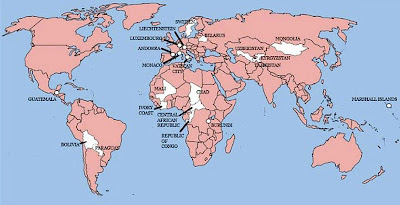
Will they? Won’t they? Finally, it looks like the question as to whether the US would attack Syria has been sorted out…at least for now. Syria can thank George W. Bush and Tony Blair (apart from the Russians): after all, had the “leader” and the poodle not embarked on the Iraq mis-adventure, chances are both Obama and Cameron would have found it easy to garner domestic support to launch their offensive on Syria. I remember this quote of the day in The Dish when Cameron was “thwarted” by the British Parliament: “I accept that Britain can’t be part, and won’t be part, of any military action on that front but we must not in any degree give up our utter revulsion at the chemical weapons attacks that we have seen and we must press this point in every forum that we are a member,” – British prime minister, David Cameron, up-ended by something called democracy. The last remark, “up-ended by something called democracy”, was meant as a wake-up call to the US Senate/Congress to do thei...

Apologies for the Past

When David Cameron apologized for Jallianwala Bagh almost a century after the event, it hardly created a ripple. About the only thing it did was to make people realize the Brit PM was in town! So I found this Guardian article on the apology interesting: it said such a late apology hardly helps anyone. In fact, the article said, the timing of the apology seems suspect given that Cameron came as part of a trade delegation to one of the fastest growing economies of the world. Instead, if Britain was truly apologetic, the article recommended making the teaching of both the good (Indian civil services, educational reforms, the railways) and the bad of British colonialism (other massacres, the looting etc and not just in India) a part of the British education system. Because: “For we must never forget that whatever its achievements, the British empire, like every empire before or since, was both gained and maintained by military might, and built over a mountain of skulls of those i...

Largest and Smartest Empire

When I was a kid, we once went to a town in Algeria to see the dunes and the desert. We’d gone on top of a minaret to see the view of the place and my dad had started taking photos with his camera. A couple of French tourists were also doing the same. Suddenly, a couple of cops came up and were screaming that photography was prohibited. Turned out there was a sign but since it was in Arabic, nobody could read it. When my dad explained that to the cop, he let us off with a warning. But he was harsh with the French tourists. Much later, I understood that Algeria had been a French colony and unlike India, the Algerian struggle for independence was very violent and brutal. And so, the Algerians’ dislike for the French was extremely high. That’s in sharp contrast to the British who were both smart as well as willing to forge long term relations with almost all their former colonies. As Seth Godin wrote in his blog : “Or consider the excellent relationship that the UK has with bo...