Posts

Showing posts with the label coronavirus

One Strand? Or Many Strands?

Is there one strand (variation) of SARS-CoV-2, the coronavirus, out there? Or are there multiple strands? On 30 th April, a lab in Los Alamos, announced that a second strand “began spreading in Europe in early February”. And in Europe and the US, it rose in dominance, said the report. First, let’s see why the multiple strands possibility seems probable to many. We’re told that evolution works through random mutations. A virus, with its short life span, reproduces very frequently. Thus, logically, over so many months, surely there must be multiple strands of the virus out there, right? Ed Yong wrote this brilliant article on the topic, explaining why things aren’t that simple. Yes, he says, mutations occur. But to call a mutated virus a new strand, it must differ significantly from the rest. The keyword is “significantly”. Since we humans use that term wrt its impact on us, here’s what “significantly” means: (1) Easier to spread, (2) Increased ability to cause disease, (3)...

Coronavirus Summary

This blog is based on one of the best articles I’ve read on the whole coronavirus scene. Here’s what Ed Yong has to say. What’s in a Name? The “coronavirus” is the name of a class of viruses (500 of them till date), not the one virus that has made it so (in)famous: “SARS-CoV-2 is the virus. COVID-19 is the disease that it causes. The two aren’t the same. The disease arises from a combination of the virus and the person it infects… Some people who become infected never show any symptoms; others become so ill that they need ventilators... The virus might vary little around the world, but the disease varies a lot.” The silver lining so far? “There are no signs of “an alarming mutation we need to be worried about,” Gralinski says. For now, the world is facing just one threat.” Wide Range of Impact : Unlike good old measles and malaria, SARS-CoV-2 has a wide range of impact on patients. This makes it very hard to analyze: “The disease seems to wreak havoc not only on ...

The Vaccine

Lots of people all the world are hoping (praying?) that there will soon be a vaccine for the coronavirus. I’ve always felt that optimism for a vaccine as solution is misplaced. Here’s why. Origin matters : Let’s face it: if China or India developed a vaccine, would most of the world trust it? Obviously not, so any vaccine has to come from the West for people to trust it. And therein lies the rub. Clinical trials take, like, forever : Any new medicine or vaccine needs to be tested first. Obviously. For side-effects. To check if it actually works. And Western systems have unfortunately demonstrated an “inability to start and run clinical trials faster”, writes Matthew Herper. Siddhartha Mukherjee had described this exact problem in the context of possible AIDS medicines in The Emperor of All Maladies : “(Clinical trials) were all well and good in the cool ivory towers of medicine, but patients affected by a deadly illness needed drugs now .” Ethics of RCT (Randomized Co...

The Puzzle Named India

This is a question more and more people are asking about India : “How has the country, whose per capita income is just tenth of the US, avoided being flattened by the pandemic?” The authors, Anup Malani, Arpit Gupta and Reuben Abraham start with the 3 commonly cited reasons. Epidemic hit India later than the West : Incorrect, say the authors. The first cases landed in Kerala in end Jan. And other cases arrived in early March. Lockdown and social distancing have worked : Maybe, maybe not, they write. The virus has a gestation period, so there is a time lag between the lockdown and its effect. In any case, there are several well-known events violating the lockdown e.g. Tablighi Jamaat in Delhi, migrants at Bandra etc. And even if the lockdown has worked, it raises a scary prospect: “If India’s caseload is low because of the lockdown, it will not help when the lockdown ends.” Not enough testing and thus the reported numbers are wrong/low : Yes, we don’t have enough te...

Coronavirus and Value Systems

Why has there been such a sharp difference in the impact of coronavirus between East and West? From everything I’ve read, it seems like the root cause lies in the value systems of the two sides. Ironically, the very values and beliefs that served  the West so well have now become an albatross around their necks. Definitions, Definitions : Take the basic question asked from early on, “Is coronavirus airborne or not?”. Believe it or not, the word “airborne” has a very different definition than what the layman thinks! Ed Yong explains : “When people are infected with respiratory viruses, they emit viral particles whenever they talk, breathe, cough, or sneeze. These particles are encased in globs of mucus, saliva, and water. Bigger globs fall faster than they evaporate, so they splash down nearby—these are traditionally called “ droplets .” Smaller globs evaporate faster than they fall, leaving dried-out viruses that linger in the air and drift farther afield—these are called “...

Coronavirus: Death Rates

Image
What fraction of infected people are dying of coronavirus? Some sites and reports are using this formula:   That formula comes up with low ratios. Unfortunately, it is wrong. Why? Because most cases are still ongoing/active/open and they could end either way: in recovery, or in death. The right formula to use is: By that second formula, the death rate globally is 19% . That means 19% of infected people died. It does not mean 19% of people in the world have died. With me so far? So far it was just logical thinking, but now it gets messy across different countries. The death rate in UK today is a staggering 93%, while Germany is at just 4.6%. How can there be such a huge difference in death rates across rich Western countries? Are Germans that much healthier than the Brits? Are healthcare systems that different in the two countries?  Nope, the answer lies elsewhere, as this article says: “If a country carries out more tests, and also identifies people ...

Coronavirus: Do Lockdowns Work?

Image
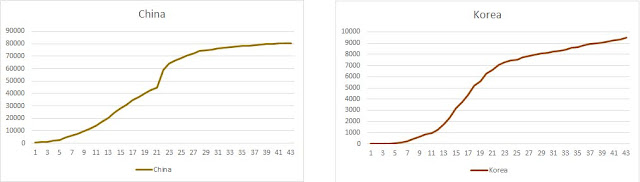
In my last blog , I asked if we should look East, i.e., at how China, Japan and South Korea are dealing with coronavirus. Since those countries got hit first (whereas Europe and the US got hit later), there’s data for a far longer period from the 3 Asian countries compared to the West. To adjust for that, I’ve taken the total cases count for the first 43 days in each country (that corresponds to present day for most of the West). First up, China and South Korea: Don’t worry about the exact numbers. Look only at the shape of the curve for both countries: a slow rise (few new cases per day), that changes to a steep rise (lots of new cases per day), and by Day 25 or so, both countries managed to flatten the curve (back to few new cases per day). In other words, Day 25 corresponds to the time when the effects of their lockdowns began to show up. Next, look at Europe and the US for the same period (first 43 days): The curve starts picking up much later (there’s the ges...

Coronavirus: Looking for Patterns?

As India nears the completion of Week 1 of a nationwide Coronavirus lockdown, in places like Bangalore, one can see folks cite what other countries are doing and suggesting we do the same in our apartment complexes. Are they justified? Or over-reacting? Are the countries being compared, well, comparable? First, let me call out my source for the analysis below. It’s this site that captures Coronavirus stats from all countries . It captures infection counts, recoveries, deaths and active cases on a daily basis and also plots graphs of the same over the last few weeks and months . On some topics, I do see patterns across countries. On others, hardly. And in yet others, patterns seem limited to race (Asians, Europeans etc), or to population size, or to climate. But the key is that one can’t be sure and no pattern is universal… yet I find most people talk as if there is certainty on all such matters. Take China and South Korea : only 4.2% and 2.9% of infected cases have res...

Epidemic Yoyo

China and Italy. Opposite sides to the handling of the Coronavirus. The former appears to be the role-model-if-not-for-this-annoying-thing-called-freedom, while the latter is the origin of the meme “Let’s not be Italy”. Then there’s the UK, writes Santosh Desai. Crudely put, their approach sounds like this: Few people will die. The rest will recover. Just let it play out without any extreme measures. That sounds heartless, so what’s the though process? “The logic employed is that in any case, in will be impossible to prevent this from happening regardless of what actions are taken today. Strict lockdowns might work temporarily but as soon as these are relaxed, the coronavirus is likely to make a strong comeback, the argument goes. Once a majority of the population gets infected and thus becomes immune to the disease, then the virus loses its contagiousness and could get permanently controlled.” Or is the UK approach about sheer pragmatism, writes Tyler Cowen: “For how ...

Epidemic as a Mirror on Society

In a recent blog , I said that the coronavirus wasn’t an epidemic yet, regardless of the panic and fear. Sadly, now it’s official, writes Ed Yong: the WHO declared it a “public-health emergency of international concern” (PHEIC) — a designation that puts it in the same bucket as the infamous epidemics of H1N1 swine flu, polio, Ebola, Zika, and Ebola again. In his article, Yong focusses on the following aspect: “Each epidemic is also different, and each is a mirror that reflects the society it affects.” Let’s explore that line in detail. Coronavirus seems to be spreading at a blistering pace compared even to SARS, which for all the hue and cry, infected 8,100 people in 8 months . But that’s not an apples to apples comparison, say many. Back then in 2002-03, the world didn’t know how fast and how wide a new virus could spread. Today, we have panic, which leads to more people checking in for anything resembling the symptoms. Plus, the number of people flying across the world ha...