Posts

Policy Analysis: Sugarcane

Pranay Kotasthane pointed out that sugarcane prices did not spike despite the sharp increase in demand due to all the harvest festivals recently. Being a policy analyst, he tried to find out why that is the case. He found that global sugar and sugarcane prices have barely increased over the last 25 years (adjusting for inflation) even though incomes have risen across the world.   First, countries subsidize sugarcane production. Combined with better yields, it has resulted in a huge increase in sugarcane production, even over-production in India and Brazil. Then he zooms into India.   The Indian government tries to juggle two contradictory aims – keeping the cost of sugar low for the consumer while also ensuring a fair price to sugarcane producers. To avoid sharp price increases that would hurt consumers, the government procures and sells via ration shops. It also proactively bans exporting sugar if it anticipates a rise in inflation.   But the sugarcane farm...
Past and Future of Hindutva

I found Raghu S. Jaitley’s post on the Ayodhya ceremony on 22 nd January interesting. He starts with the late 80’s, when Hindu assertiveness started off – slogans like “ Garv se kaho hum Hindu hai ” (say with pride that we are Hindus). “In about a year from then, the Ram Janmanhoomi movement began dominating the Indian political landscape. The door-to-door collection of bricks for the shilanyas, the daily reports of the L.K. Advani’s Rath Yatra and the trail it left behind and lumpenisation of Jai Shree Ram and Jai Bajrang Bali all followed soon after.” While it increased the Hindu assertive footprint, it was still limited to pockets of the North, nothing more. But eventually, it led to huge political wins: “To those who grew up in the 80s, the events on the 22 nd of January… will bookend a political issue that dominated all our adult lives.”   While the timing was deliberate (close to the next Lok Sabha elections), it raises a new question, sa...

Two Island Nations

Recently, two different tiny island nations turned pro-China – Maldives and Nauru. The Maldives case we know well (and care about) in India. A common consequence in both nations’ pivoting to be pro-China was something Indians don’t really care about – the stance on Taiwan. Both Maldives and Nauru declared that Taiwan was an inalienable part of China, there can only be one Chinese government etc.   Are these signs that China is “winning”? Not really.   The reason both countries pivoted to China was good old money. In Maldives’ case, it owes China a lot of money (by their standards), aren’t in a position to make their EMI payments, and therefore need the lender (China) to either extend the term of the loan or to defer payments.   This may be sound surprising to Indians, who see Maldives’ stance as driven by the new Islamist-leaning leader. Sure, yes, in Maldives politics, alternate leader flip-flop between India and China. But the problem of paying back to China...

Bangladeshi Textiles

Image
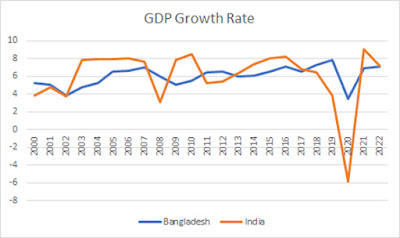
For quite some time, I was hearing that Bangladesh was growing fast, that it was even outperforming India. I finally got around to pulling up the data on the two countries only recently and here is how the comparison looks:   The graph shows that Bangladesh hasn’t outperformed India, but yes, it has been growing steadily at a good pace and in some years, grown faster than India.   In one sector though, Bangladesh has eaten into India’s share – textile and apparel exports. Pranay Kotasthane looked into how and why that has happened. The reason this sector matters, he says, is that it can employ a lot of people and it doesn’t require any educational qualifications, thus making it a great fit for our population.   One reason is that the West has given preferential treatment to Bangladeshi exports as part of its policy of helping poorer countries. The other major reason, he says, is a self-inflicted wound by India. Let us understand that next.   The global ...

Rajasthan #5: Language

A couple of things from our Rajasthan holiday resonated with what I had read in Peggy Mohan’s Wanderers, Kings and Merchants . When I commented to the hotelier it was good for tourists like me that everyone spoke Hindi, his reaction surprised me. No, he said, it’s only Jaipur that has adopted Hindi. The rest, he said, have been learnt Hindi because (1) none of the state’s languages are recognized in the Indian constitution; and (2) the most common medium of education in the state is Hindi.   He then added that a couple of MLA’s in the recently concluded state elections took their swearing-in oath in Marwari. But then had to re-take it in Hindi as well since (obviously) you can’t take a constitutional oath in a language not recognized in the constitution. Ironic? Amusing? Hurts? You decide.   We are Marwaris, he then added proudly, we speak Marwari. I remembered Mohan’s point that many languages in north India that we take to be dialects of Hindi are, in fact, closer to...

Indian Languages #5: Rise of Hindi

The rise of Hindi. How and why did it happen? When languages clash for dominance, writes Peggy Mohan in Wanderers, Kings and Merchants , here is how things proceed. “Hindi, Braj and Awadhi did not sit down at a table to resolve their differences, shaping themselves into a single language with the best features of all… Like nature (the fight) is red in tooth and claw.”   Braj and Awadhi were older languages, with literature of their own. And yet Hindi won. Why? “There is nothing like being situated in a large urban center of commerce and political power (i.e., Delhi) to give a language an edge, even if the inner circle is speaking something else.” British rule then sealed the dominance of Hindi: “In British times, Hindi began its growth as a modern language of literacy, all the languages spoken in its sphere of political influence declared their loyalty.” Inevitably then: “As the size of the (Hindi) shadow grew, more and more of the one-time competitors found themsel...

Rajasthan #4: A Tale of Two Hotels

Image
Since ours was a last-minute trip to Rajasthan, we ended up in a hotel in a visibly run-down part of Jaisalmer. Narrow streets, garbage strewn everywhere, open drains, cows everywhere… you get the picture. (But like everything else in the Golden City, the hotel and buildings near it had the palace look and color).   This hotel even had a Terms & Conditions (T&C) card in the room; I’ve highlighted the funniest parts:   It was the kind of hotel where you have to call the Reception to operate things in the room (TV – where are the remotes? Geyser – master switch at the Reception). You get the idea. But hey, it offered free Wi-fi (but you had to ask Reception to get the password), which was all my 12 yo daughter really wanted. And she had a good laugh reading the T&C card. So did we. ~~   Meanwhile, at the other end of the hotels spectrum in Rajasthan are the heritage palace-turned-to-hotels. Of the palaces converted to hotels, some are way too expen...