Posts

COVID-19 Death Rates

Why COVID-19 death rates in poorer countries remain far, far lower than richer countries is a question that intrigues many. Best-selling author Siddhartha Mukherjee’s analysis of the subject is nuanced. As icing on the cake, given his Indian connections, there’s a lot of India-specific information.   Many feel the average age of different countries has a big role to play. After all: “After the age of thirty, your chance of dying if you get covid-19 doubles roughly every eight years.” But in India, he says that old people seem resilient, many of those “in their seventies and eighties” who contracted COVID-19” have “bounced back”.   Or is it that the “spatial distribution of the elderly” matters? In India and poorer countries, the elderly are generally with (younger) family. Whereas in the West, they’re concentrated in old age homes where it spreads like wildfire.   Perhaps average age is too broad a categorization. Do the details of age distribution matter...
GPS - More than Just a Navigation Tool

What is the economic value of GPS today? In his book, Pinpoint , Greg Milner answers that with these outrageous lines: “Placing an economic value on GPS has become nearly as impossible as pegging the value of other utilities. How much money do electricity and telephones generate?” C’mon, I thought. Those are essentials, GPS is just a convenience. Milner went on to show how little I knew about the uses of GPS...   Heard of precision agriculture? Nope? When farmers plough their fields, the result is obviously not flat. That unevenness leads to an uneven distribution of water via irrigation. So they tried this experiment in India’s own UP: a two-acre farm was split in 2 halves, one ploughed by ox, the other by a small precision leveller using GPS (see how that works? If the land is uneven, different parts of it will get the GPS signal at slightly different times, since one part is a bit “up” and the other a bit “low”. The precision leveller, er, levels this by using GPS signal...

Symptoms and Infectivity - the Order Matters

In the age of COVID-19, we hear a lot about the Spanish flu epidemic from 1918-19. Though it was found in the US, France, Germany and UK first, yet it came to be called the Spanish flu. Why? Because it happened during a World War! “To maintain morale, World War I censors minimized these early reports. Newspapers were free to report the epidemic's effects in neutral Spain… these stories created a false impression of Spain as especially hard hit. This gave rise to the name "Spanish" flu.”   And how far did it spread and how many did it kill? Wikipedia again: “It infected 500 million people – about a third of the world's population at the time – in four successive waves. The death toll is typically estimated to have been somewhere between 17 million and 50 million, and possibly as high as 100 million, making it one of the deadliest pandemics in human history.”   If that’s not scary, consider this additional point from David Quammen’s book on inter-species di...

Bitcoins - Currency or Asset?

A few years back, I’d written a blog on Bitcoin, the digital currency. Yes, Bitcoin is like the dollar, pound, Euro or rupee. It’s a currency. Except it isn’t issued by any government. We won’t get into the technical details of who creates it, fraud prevention etc here.   Bitcoin’s exchange rate against the dollar (and every other government issued currency) keeps making headlines regularly. For both its sharp rise and for its sharp falls. Over 10-15% drops over a weekend aren’t unheard of.   Over the years, Bitcoin hasn’t taken off as a currency at all. As James Surowiecki wrote recently: “Almost from the beginning, only a small percentage of Bitcoin transactions have been for actual goods and services — and of those, many have been for illicit goods and services, like drugs and online gambling.” And today? “On average, there are now around 325,000 Bitcoin transactions — including trades — per day. There are roughly a billion credit card transactions per day.”...

Sepia

Image
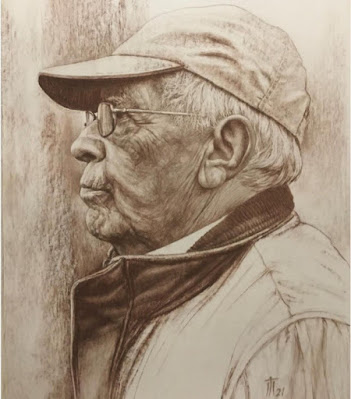
Thanks to the smartphone and all its apps with filters to apply on your photos, everyone’s heard of “sepia”. Here’s a pic with the sepia effect:   Sepia is a 130 year-old technique (!) of using a toner while developing photographs. It only works on black and white photos: “The print is first soaked in a potassium ferricyanide bleach to reconvert the metallic silver to silver halide. The print is washed to remove excess potassium ferricyanide and then immersed into a bath of toner, which converts the silver halides to silver sulfide.” The outcome is lots of shade of brown, but ultimately, it’s all brown and white. Therefore, technically speaking, sepia is still a monochromatic image.   Why did this method evolve? For aesthetic and practical reasons. It gives the pic a slightly warmer effect. And because of those chemicals involved in the different steps, the outcome is a photo which is more resistant to exposure to the elements. Longer lasting photos, in other words....

"Great Artists Ship"

Image
I was reading Walter Isaacson’s book on Leonardo da Vinci, in which apart from the man’s life (obviously), describes many of his paintings and the techniques used. Now it’s one thing for a lot of effort, analysis, and practice to have gone into a work of art, but if the viewer needs to be told how to appreciate a painting, then something’s not right… I guess that’s why I’ve never liked any of Leonardo’s paintings. Give me the works of Norman Rockwell, van Gogh, and Leonid Afremov any day.   But just as Michelangelo is the synonym for artistic genius, Leonardo’s Mona Lisa is the synonym for best painting. I realized this when my 9 yo daughter was painting on canvas a mountain-lake scene from a YouTube video. Given how good the painting on the video was, I told my daughter to take her time, even spread the effort over a few days if needed. She whirled around and asked, “Why? How long did it take to paint the Mona Lisa ?”   Thanks to that book I was reading, I knew the...

Archimedes, Far More than the Eureka Man

In his book, Is God a Mathematician? , Mario Livio calls Archimedes one of the greatest mathematicians of all time. He calculated the “areas of the circle, segments of a parabola and of a spiral, and volumes of segments of cylinders, cones and other figures”. He proved that pi lies between 3 10 / 71 and 3 1 / 7 . In physics, he discovered the laws of floating bodies and the laws of levers.   Then, of course, there’s the famous Eureka story. But was that real? This podcast points out that Archimedes never mentions it in his own books, and the first mention of this incident occurs 200 years after his death. Centuries later, Galileo pointed out that while the idea of relative displacement was correct in theory, the difference in case of a crown would be too small to be detected using the measuring instruments of the time.   Most interestingly, Archimedes has a parallel with Alan Turing, the man who cracked the Enigma code in World War II. While both men were great math...