Posts

Religion and the Internet

MIT’s Technology Review talked about this study that claims that “Using the Internet can destroy your faith”. As expected, this was a lightning rod for Slashdotters . Peragrin said: “great. now the christians are going to call the internet the tree of knowledge and get it declared forbidden in their quest for religious zealotry.” Would that make Steve Jobs the devil? After all, Apple computers and Apple phones are used to surf the Net! This guy with the ID, Opportunist, demo’ed his knowledge about well, knowledge: “Lucifer, as Satan is often called, can easily be translated as "he who brings the light" or "he who carries the light (to someone)", deducting from "lux", light and "ferre", carry, bring. His story is not too different from that of Prometheus, who served that role in the Greek mythology. And they're by far not unique. In other words, they were "evil" enough to bring light and enlightenment to human, rather th...
Invest in a Sports Star

Financial innovation. Financial engineering. They have become very negative terms ever since the crash of 2008. And yet, not all financial innovation is bad (obviously). Recently, I read about an interesting instance of such innovation. Every time you hear of the astronomical earnings of a Virat Kohli, have you wished that you could invest in a sports star? The way you do in stocks? In such a system, investing in the star would entitle you to a fraction of all future earnings of that player both on and off the field. Yes, that means a share of his/her endorsements too! Ok, but why would any sports star agree to such a deal? Two words: risk reduction. Imagine you’re a player who is on the rise. You know that, even though you are talented, a lot of things can go wrong in the future. So to de-risk things, in return for handing over the above mentioned share of your future earnings, you get a lump sum upfront payment from those investors today. Guaranteed. Money you don’t have to...

How Probability Saved the World!

When the Soviets wanted to assess what chance they had of winning a surprise preemptive nuclear war against the West (before, of course, the West launched one)? What fraction of nukes should be used? What fraction should be reserved for re-retaliation against the inevitable retaliation? What fraction of bombs on either side would misfire or be inaccurate? What were the odds of taking out the Western communication systems in a first strike? How many Western submarines might be close to the Soviet coast to launch their missiles? How much damage might the bombs do? When there are a huge number of variables, and the odds of each of those variables can be different every hour, statisticians do multiple runs with different numbers probabilities in each run. This is called by a racy name, Monte Carlo runs. And Monte Carlo runs is exactly what Colonel Valery E. Yarynich did to evaluate the USSR’s chances. And with so many variables with unpredictable probabilities in the equation, Ya...

Nukes

I remember this lesson at school about the effects of the Hiroshima (or was it Nagasaki?) bombing. It left me, well, totally untouched. I guess it was poorly written or maybe I was too young for it. Also, it didn’t have sound bites, like the International Court of Justice ruling that said: “Their destructive power…cannot be contained in space and time.” Space and time. So Einsteinian in its sound. Kind of ironic, isn’t it? Recently, I read a book titled “How the End Begins: The Road to a Nuclear World War III” by Ron Rosenbaum. I am totally unmoved by any of the let-us-get-rid-of-nukes argument the book had. Mostly because the genie is well and truly out of the bottle. How would you ensure everyone not only eliminates their stockpiles but can also be trusted to not build them again ever? Besides, I am not worried about nukes with the Americans, Russians, Chinese, Brits, French, Israelis and Indians since they all desire to live; none of them is suicidal. That leaves the Paki...

Knowns and Unknowns

Take a minute to read these lines from Plato’s Apology : it is from Socrates’ defense: “I am wiser than this man; it is likely that neither of us knows anything worthwhile, but he thinks he knows something when he does not, whereas when I do not know, neither do I think I know; so I am likely to be wiser than he to this small extent, that I do not think I know what I do not know.” While the sentiment is definitely true, the wording is, well, heavy. Not easy to read. Now contrast that with how the same sentiment was expressed by Donald Rumsfeld: “There are known unknowns. That is to say, there are things that we know we don't know. But there are also unknown unknowns. There are things we don't know we don't know.” Known unknowns. Unknown unknowns. Trust an American to explain an idea in simple (and oh yes, very quotable) terms! Errol Morris, however, warns us of the dangers of the above approach taken too far: “Progress hinges on our ability to discrimina...

Life Imitates Cartoons

Image
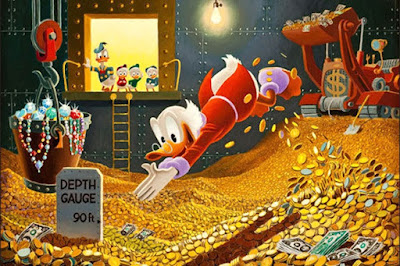
It is standard practice for banks to lend money to the central banks (equivalent to RBI). In the current environment of Europe, banks don’t want to lend to customers and businesses because they consider that very risky. So they lend instead to the European Central Bank (ECB). Not happy with this, the ECB reduced the interest they pay on such loans to be negative. Yes, negative. But what does that even mean? It means the banks have to pay the ECB interest to take their money! As this article said : “The idea (is) that you can make not-lending so costly that lending starts up again.” But no: turns out that the banks would rather hoard the cash than lend it! Of course, hoarding doesn’t come for free either. It adds to storage costs, the cost of keeping all that money in giant, secure vaults. And transportation costs to move that money around. Additionally : “Bank robbers, earthquakes and other unforeseen disasters, on the other hand, are a problem. Or rather, the delicat...

Changing Our Beliefs

If you thought that the way to get people to make the right choice was to provide them with more information or even better, teach them analytical skills, then you would be disappointed by what Yale law professor Dan Kahan found. Erza Klein describes his findings in the article : “People weren’t reasoning to get the right answer; they were reasoning to get the answer that they wanted to be right...More information, in this context, doesn’t help skeptics discover the best evidence. Instead, it sends them searching for evidence that seems to prove them right. And in the age of the internet, such evidence is never very far away.” Kahan says he is not surprised that “we react to threatening information by mobilizing our intellectual artillery to destroy it”! But why are we like that? Perhaps Mary Douglas has the answer in her book, Purity and Danger : “In perceiving we are building, talking some cues and rejecting those which fit most easily into the patter that is being buil...