Posts

Classification Systems

We have a tendency to classify things into categories. It helps organize information and find things easily. Most of us are aware of one or the other classification scheme in areas like music, sciences or literature. One of the most famous classification systems is the Dewey Decimal Classification system (DDC) used in libraries all over the world. But is it “fair”? Look at how it divides the religion space. 70% of the religion space is reserved for Christianity. Islam and Hinduism are clubbed with “associated” religions (like Bahai and Buddhism) and get less than 2% of the religion space (even though, put together, they are followed by more than one third of the world’s population!) So was Dewey biased? Maybe, maybe not. His system was devised to optimize shelf space for books. No prizes for guessing which religion had the most books in the land Dewey lived in… So you realize classification systems are devised with an aim in mind (like optimizing shelf space). If you have a different ...

Cure is (Sometimes) Better than Prevention

"Institutions will try to preserve the problem to which they are the solution." - Clay Shirky That sounds cynical. It also sounds true. But ever wondered why things are that way? It’s not only because of the preserve-the-problem-and-keep-making-money mindset at work. Things are a lot more complicated than that. Take the example where a company can eliminate the problem instead of just fixing things when they go wrong. If each and every company goes with this approach (eradicate the problem) then, it will make money only until the problem is eradicated. But what does the company do after the problem is eradicated? They’ll have to find another problem to solve. Will they succeed at finding that next solution? Not necessarily. If they don’t, the company would close down (remember, the older problem they fixed is now eradicated). And then their employees will be without jobs. Which do you prefer? Problem eliminated, but unemployment added? Or jobs retained and cure available, but...

Overly Sensitive?

Many Indians were upset with an article in Time magazine criticizing Indians. Apparently, so many Indians voiced their unhappiness with the article that both Time and the author, Joel Stein, posted apologies (You can see them at the end of the article). For a change, it wasn’t about the IT folks who “steal” American jobs. Rather, it was a criticism of Indians who live in the US. Or more specifically, the ones who live in one city: Edison, New Jersey. Most Indians familiar with the US know of Edison for that very reason. But hey, let a white guy say the same thing and we are up in arms! As long as we are spoken (and thought) highly of as the smart doctors and software engineers from India, we are very lapping up the complements. We love it when the Americans “ assumed all Indians were geniuses ”. Then, says Stein, some of those “geniuses” in Edison started bringing in their “ merchant cousins ”. Who in turn brought in their “ even-less-bright cousins ”. And then he says, “ we started...

Why Petrol Price Deregulation is Good

Image
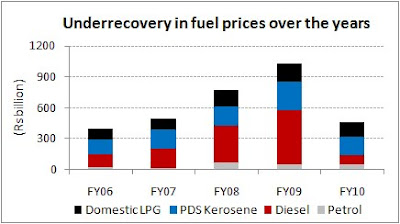
The decision to deregulate the price of petrol went mostly uncommented on. “Deregulation” means that the Government of India ( GOI ) will not set petrol prices anymore; instead companies will. In other words, petrol prices at the pump will be decided by global crude prices. Before deregulation, GOI set fuel prices to be lower than global prices. Take a look at the chart below. It shows the cost of fuel price subsidies to companies: Source: Petroleum Planning and Analysis Cell By deregulating petrol prices, at least losses on the petrol front get eliminated. (By the way, this explains why Shell’s pumps charge a higher rate: they have been charging unsubsidized rates. And why GOI owned oil companies like HPCL and BPCL are often loss making ). But what’s the problem with continuing the subsidies? Well, someone has to pay for the subsidies eventually. So who pays? People like us. Parts of our taxes are used to bear the subsidy cost. Also, these subsidies show up as GOI debt. High GOI...

Discover the Law

Most people in 3 rd World countries (and even the emerging economies of today) don’t observe laws and rules. Is that because the probability of getting caught is negligible? Or are they inherently a “rules are not for us” bunch? Or is there something more to it? Check out this comment by the legal scholar, Bruno Leoni: “The Romans and the English shared the idea that the law is something to be discovered more than to be enacted and nobody is so powerful in his society as to be in a position to identify his own will with the law of the land” Leoni is right. There’s only so much that can be enforced. Unless the majority agrees with the rules, it’s practically impossible to apply them. The rules of most of the “non-law abiding” countries were enacted by their colonial rulers. Had they been discovered , they would have been in sync with the local customs and practices. Could it then be that most people in these countries do not follow the rules because the rules a...

Sports Decisions and Tech Aversion

It was Wembley, 1966 all over again. This time, though, the decision went in favour of the Germans. Goal scored but (this time) not given by the referee/linesman. Did that decision change the course of the match? That, of course, is debatable. Some would say that because the goal was not given, England threw everyone into attack; and when the Germans counter-attacked, there was nobody at the back to defend. Others would say Germany was the better team and would have won in any case. But let’s leave aside the exact impact of that decision on this particular match. The Americans use technology to make decisions in (American) football and basketball. Apparently, their fans have enough to argue and discuss in terms of who should have played and what strategy should have been adopted! Sports like cricket and tennis use Hawk-Eye to trace the ball’s trajectory to predict where the ball would have gone or landed. Is that perfect? Obviously not; but at least, it is consistent to both teams. B...

What do you with a Problem Like Vuvuzela?

Image
When you think of the ongoing World Cup, what comes to your mind? The French team’s strike ? The pathetic referee’ing, like when Kaka got a red card ? The abuse hurled at the Jabulani football in use? Portugal’s goal feast against North Korea? Or your favourite team’s performances so far? If you said Yes to any of the above, you’d be in a microscopic minority! Most people only think (or is it hear?) of the sound of a million angry bees swarming. In other words, the instrument known as the vuvuzela . Yeah, yeah, I know. It is a part of South African culture. We should be tolerant. But come on. It drowns the sound of the fans cheering. Ever wondered what’s a World Cup without the sound of Brazilian music and drums? Well, now you know. It’s not as if this horrible instrument is played only when the play is interesting. Or boring. Or when a goal is scored. They blow on it for all 90 minutes. Of every game. Given these South Africans’ lack of knowledge or interest in what’s worth cheering...